
Whenever I get a new guide book, I look up the shopping section and search for book shops. As was also the case when I opened my new ’Made in Kolkata’ and found Earthcare Books. Located only a short walk off Park Street, the shop was an easy find on Middelton street. I walked into a courtyard and found the shop behind a cafe.
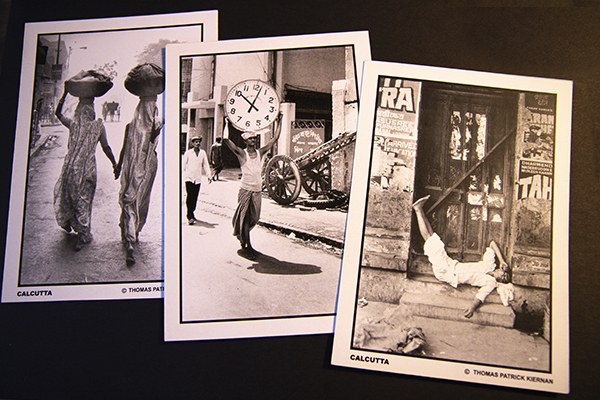
Earthcare Books is small and just the kind of bookstore I love, it also has a section for gifts and cards. But what caught my attention was the black and white postcards and prints by Irish photographer Thomas Patrick Kiernan. The photographs were taken on the streets of Calcutta and in some other cities in India; the motifs well known, but captured beautifully.
Having singled out a few books for a maybe-later-buy, and picked a few postcards, I asked the man behind the desk for the price of the prints. “10 000 rupees he said,” which struck me as steep and too much for an impulsive buy.
I returned to the shop three days later. When I entered the courtyard, I noticed a man, obviously European, sitting outside the bookshop. We greeted briefly, and I entered the shop. I didn’t waste any time, I once more asked the same young man about the price (I could always have misheard him three days earlier), and he confirmed the 10 000 rupees. As my home-stay doubles as an art gallery, I had consulted my host and knew what I had to ask: Did the prints have an edition?
“No, they don’t,” a voice behind me said. It was the man outside the shop, he must have overheard the conversation and instinctively I knew he was the photographer – which he confirmed. I immediately felt ashamed about complaining about the price, and he must have understood, because he said, «You have any right to question the price.»
And then he went on to explain that if he numbered the prints, he would never be able to guarantee that no more prints would be made. So, better not. He invited me to sit down, and the conversation lasted for the next hour. He told me he was using old fashioned film and even in India it’s expensive to buy and develop. The paper was of a very high quality and thus expensive. «On that, I don’t budge, but it makes the prints more expensive», he said.
He offered me chai, and went out to fetch it. When the small clay cup was placed in front of me, I asked him about his camera. He picked up a small Olympus up from his bag, looking vintage – after all it’s not digital, and told me he’s always using a 50 mm fixed lens. I’m not surprised. There seems to be two kinds of photographers, especially those concerned with street photography: Those with a bag full of lenses, ready to cater for any situation. And those swearing to a fixed lens.
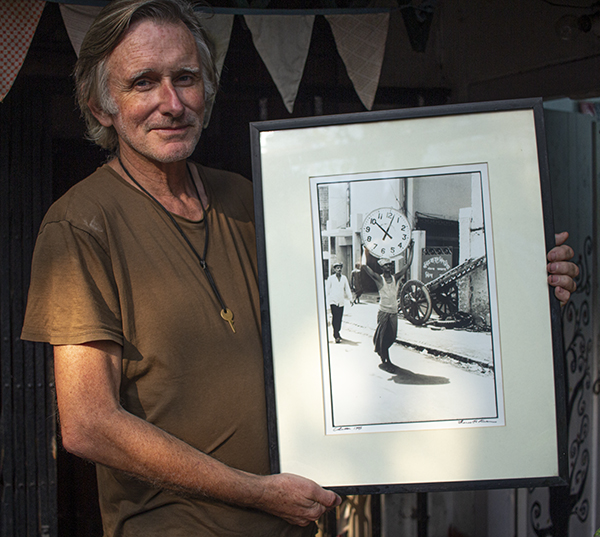
I asked him to convince me to buy The Clock, the print I had singled out, but he wouldn’t. “I’m no business man, I don’t really care if I sell my work or not.” A remark he immediately seemed to regret; I don’t think it was his intention to degrade his potential buyer.
He told me he couldn’t stay in Calcutta, or India for that matter, for more than a few months at a time, it was too much of … everything. He would go back to Ireland and do odd jobs, like gardening, but he had some money and could live a relatively comfortable life. An old Nokia phone by his side told me his needs weren’t too extravagant, and web pages and social media had absolutely no place in his life.
“Street photography in Europe is boring,” he said. “I have tried, but it came to nothing.” And we agreed that India is quite the opposite, overflowing with all kind of craze. He picked up some of the postcards I had chosen, and added, “These photos from the 90’s can’t be reproduced today. Calcutta is changing, and so is India.”
He told me how he worked, how he never planned or staged anything, and yet, his compositions are not always accidental, he showed me several of his photos with a ‘twin motif’ and only a gifted photographer would able to put his ideas into action like that. “I shan’t deny that I’m influenced by Henri Cartier-Bresson,” he said, and picked up some of the French photographer’s books to show me.
Now, he is slightly adopting a new style, and opened a mock-up of his new book, his previous book sadly out of print a long time ago. And that convinced me; the last copy of The Clock – leaning on a shelf above the entrance door, had to be mine. I would have to let go of the frame though; it would never fit into my carry-on which was all the luggage I had.
I happily walked out with the small tube containing the print, crossed the street, hurried up Little Russel Street, crossed Ho Chi Minh Street and entered into the noisy Shakespeare Sarani. I knew the way by heart now and I’d probably visit again once back in Calcutta.






 Benjamuna's Blog