Benjamuna's Blog

Stories…. with a touch of India….

Mumbai people November 2, 2010

Filed under: INDIA — benjamuna @ 5:59 pm
Tags: , ,

I take photos almost all the time when in India, but not of people I really pity. People with no dignity. There are lots of them in the streets of Mumbai.

The first time I came here, I was intrigued about the number of people sleeping on the streets, at all times. No shelter, just there, on the pavement, their only belonging a sack perhaps. Chappals have to make do as a pillow. In the city, the south part of Mumbai up to Mahim where the suburbs start, people mostly sleep on the pavements. I haven’t yet seen so many families who live their life on the pavement – but they might be there. The City is quite nice, especially in the morning. Colaba, Khala Goda, Fort, Nariman Point…. – lined with great buildings put up by the Britishers – and the green maidans. Still, the many poor people remind you constantly about the hard life of Mumbai.

People tend to walk not on the pavement itself but along the cars in the street. Now I do the same. The pavements are fully occupied with stalls, hawkers, vendors …. and sleeping people at all hours.

Aman sleeping on the streets of Mumbai.

In the suburbs you get to see all sorts of living conditions. Big areas of slums. Shacks lined along the pavements. But many are those who just live on the pavement itself. They sit around a small fire, eat some food, half naked childre crawling around or going to the toilet just there. Going by car through Mumbai on a late evening is an emotional rollercoaster.

I have never seen so many deformed people anywhere. Limbs are missing, or totally deformed – here you can see every disorder possible. Very often they move among and around the vehicles on the roads, begging for money. They search out tourists, come to our cars. It’s heartbreaking, but if you start giving money you’ve got yourself a full time job.

I couldn't resist giving this little girl some money, she was sleeping on the street. We even managed to get her to smile, after some time.

Children is another story. Many work for the mafia. They are brought from the outskirts of Mumbai into Dadar (I’ve been told) and spread around the city in order to beg all day. Strike up a conversation with a native about these issues and very often you will feel he/she doesn’t really pity. -They live a simple life compared with ours, a friend told me. – They have no rent, no maintenance, no work to worry about. They just beg and eat and sleep… Maybe you have to grow up in Mumbai to take such an attitude, for us it’s impossible.

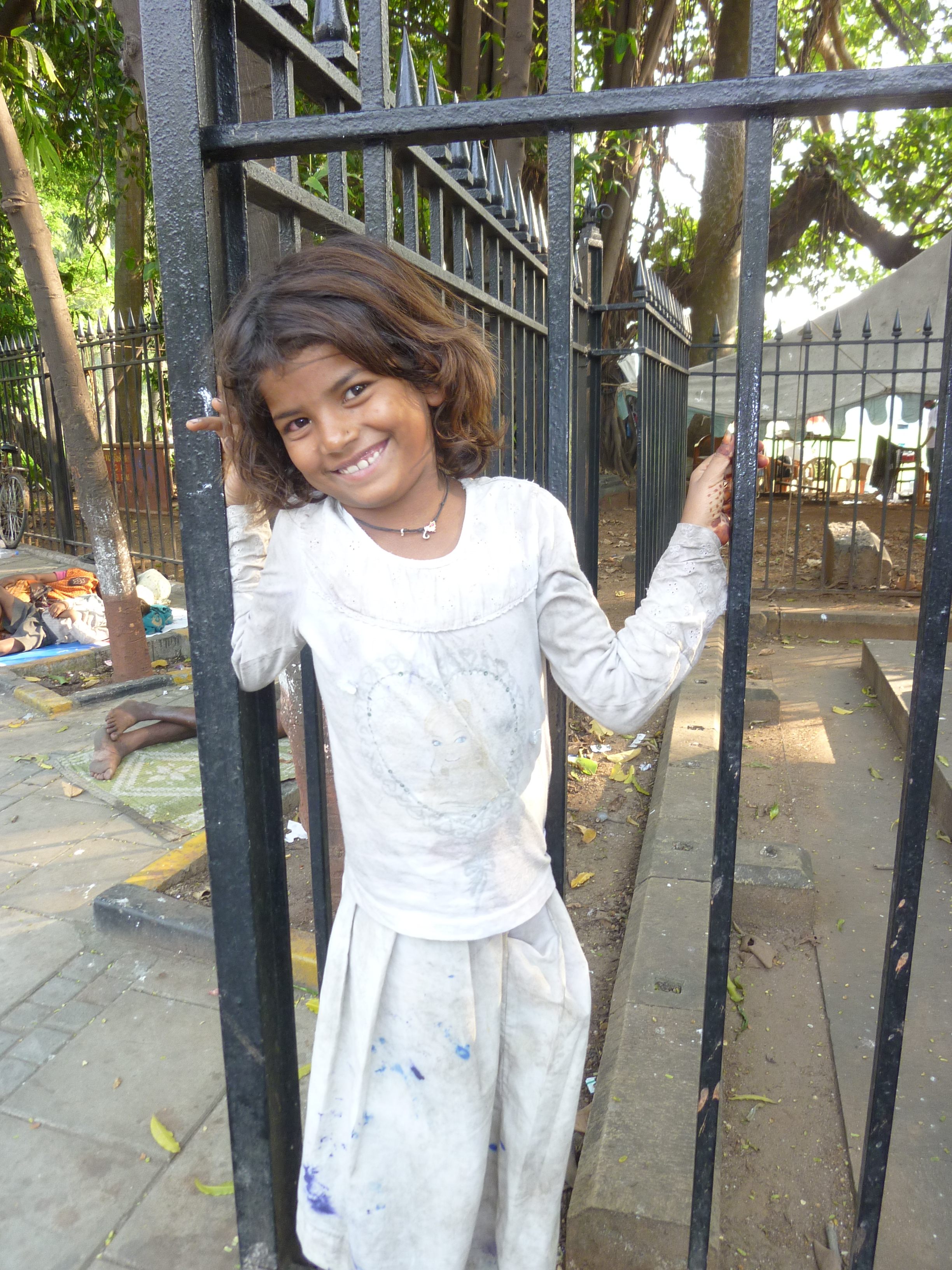
This little girl was in a hurry, but stopped for a pose AND without asking money...


Mumbai local trains November 1, 2010

Filed under: INDIA — benjamuna @ 4:46 pm
Tags: , , , ,

Most tourists don’t travel the local trains in Mumbai. Taxis and autorickshaws come cheap, and one doesn’t really bother to get to know the system of the trains. But if you really have to save money… or if you just want to have som fun… have a try.

There a re two railway lines running through Mumbai, Western Railways and Central Railways. The system carries more than 6.9 million commuters on a daily basis and constitutes more than half of the total daily passenger capacity of the Indian Railways itself. It has one of the highest passenger densities of any urban railway system in the world.

The women's compartment.

Together with my friend Joan’s son Tash we started out from Churchgate, the southernmost station, on a seemingly quite Sunday at noon. The trains have women’s compartments, but since we were a mixed couple we had to opt for the mixed compartment. Incidentially I saw a sign just as we we were boarding; some compartments are reserved for the handicapped and for cancer patients.

The train was filling up as we went along, every time I thought the compartment was absolutely packed, 50 more people boarded in a rush. I was lucky to sit, squeezed into a corner. Indian men tend to stare openly, so I had put on a cardigan which made me boil.

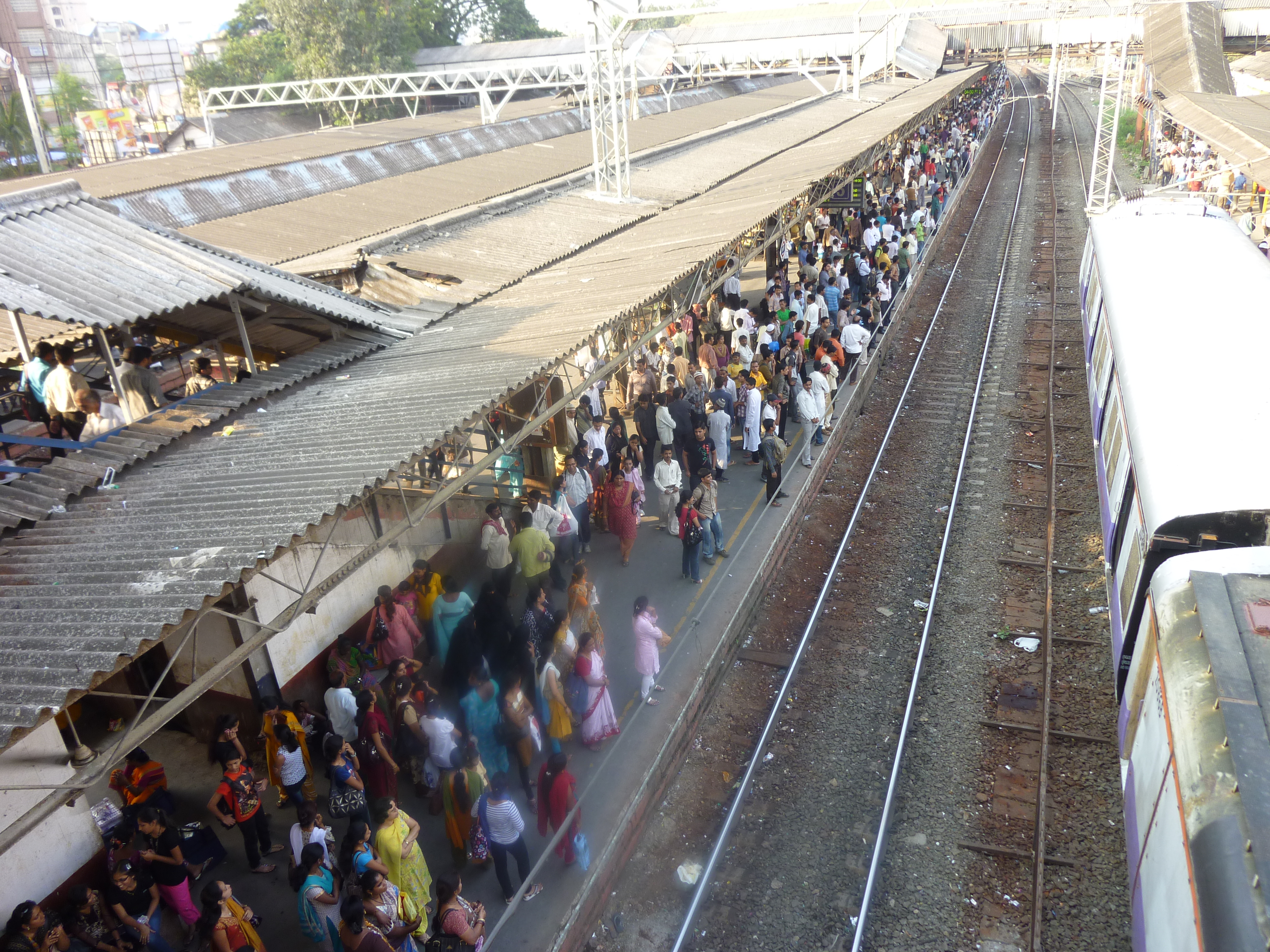
People wating at the station.

The train ride was no hassle really, but when Joan and I returned later in the afternoon, the fun began. We had boarded a wrong train and had to change only after one station. As the train came rolling into the station, everybody started to run along the train. And as we were going for the women’s compartment, a horde of women kept running…. and then jumped on the train before it had stopped. In open sandals and a long skirt I think I did nicely – for a beginner. At the same time people were getting out. The trains stop for only two minutes, so people are just frantic – to be in or out.

The compartment was really packed, – in my opinion, and most women were chatting away. According to Joan, the compartment was nowhere near packed…….
The good thing about India and its train culture, is that there is always space for more people. Nobody should be left out, the rule is – there is room for everybody. How good it is in terms of saftey, well…
The trains have no doors, that’s why you see people hanging almost on the outside of the trains. I was standing in the opening myself, allowing the warm air to embrace me. I never thought it wasn’t safe.
A lot of people live along the tracks in poor conditions. Defecating along the tracks is normal…. as well as walking along them – or on them. And children are playing. One has to see for oneself, really.

Women are shopping at local trains to kill time...

I can’t remember which station, but suddenly almost everybody went off – like a cowherd they were fighting their way out of the compartment. Indian women must be tough!

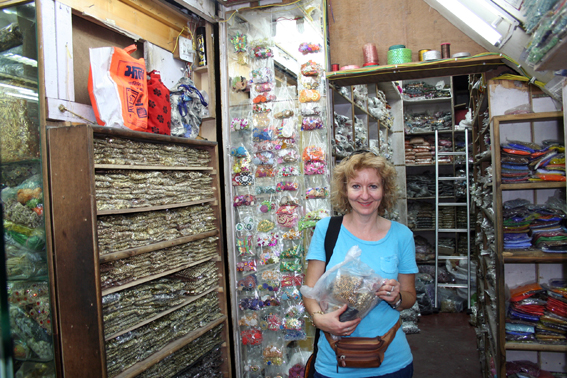
All sorts of bric a brac are sold on the trains; simple jewellerey for example. One easily gets bored on a train ride through Mumbai that takes more than an hour depending on if it’s a fast train or not. One might as well by some earrings for 20 rupies.


Colaba local market (South Mumbai) October 31, 2010

Filed under: INDIA — benjamuna @ 3:17 pm
Tags: , , ,

This morning I decided to go for a walk, just a Sunday morning walk. I ended up at the local market, and what a relief – I was not bothered by anybody. The Colaba street market, along Colaba Causeway, is different. It swarms with tourists, and you can’t take a single step without being offered something; Madam, look Madam, scarfs, pashminas, shawls Madam.. On top of it the beggars of course. You have to fight for your purse….

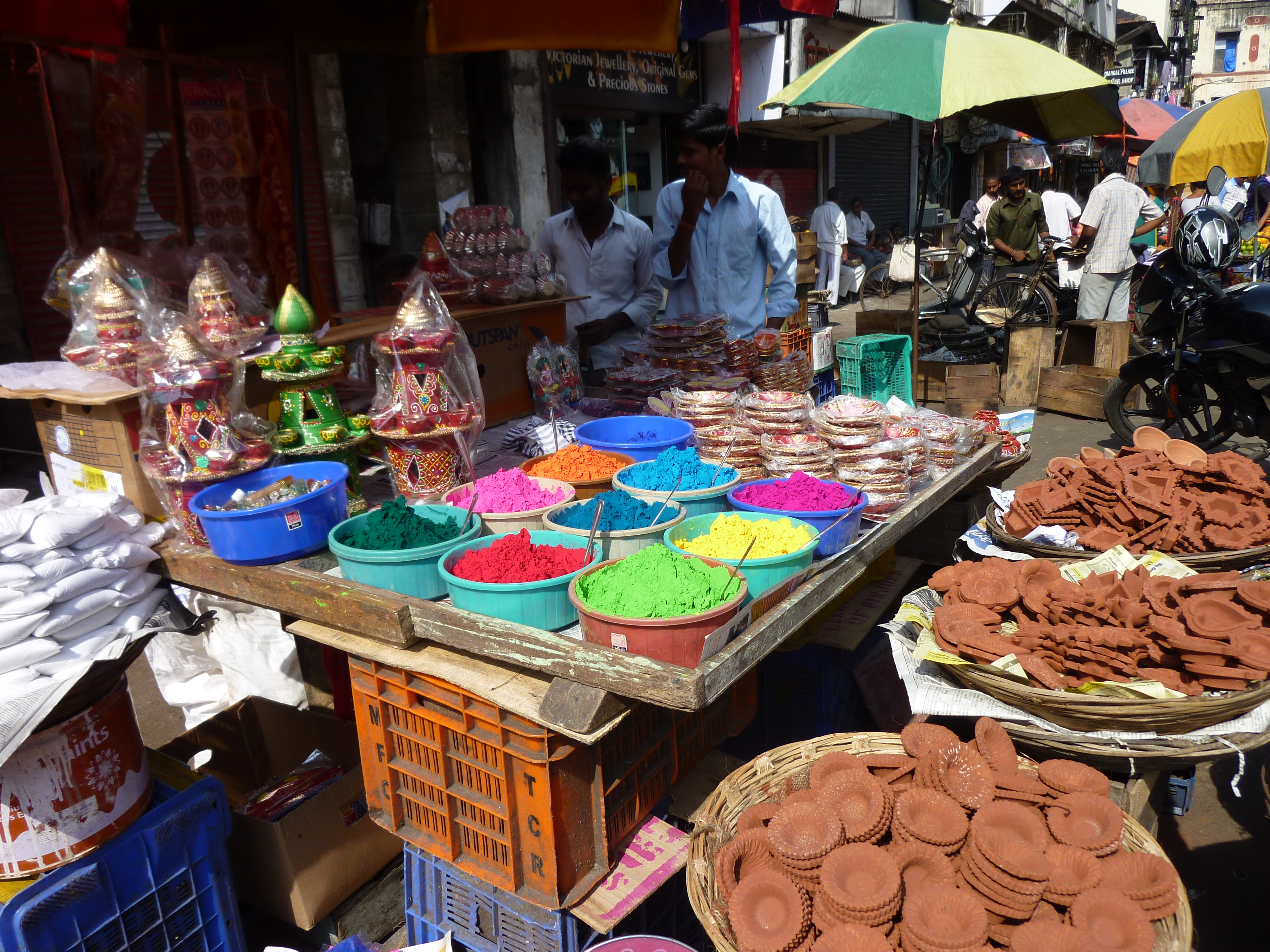
I represented no potensial byer in the local market, obviously. What would a tourist need grocieries for, or bric a brac for upcoming Diwali? I was left to myself with my camera, and people willingly answered all my questions; what is that for, how do you use this – and so on. It’s amazing these markets, and shops – the variety of goods is without limits.

I couldn't get my eyes off the powder... colours are amazing...

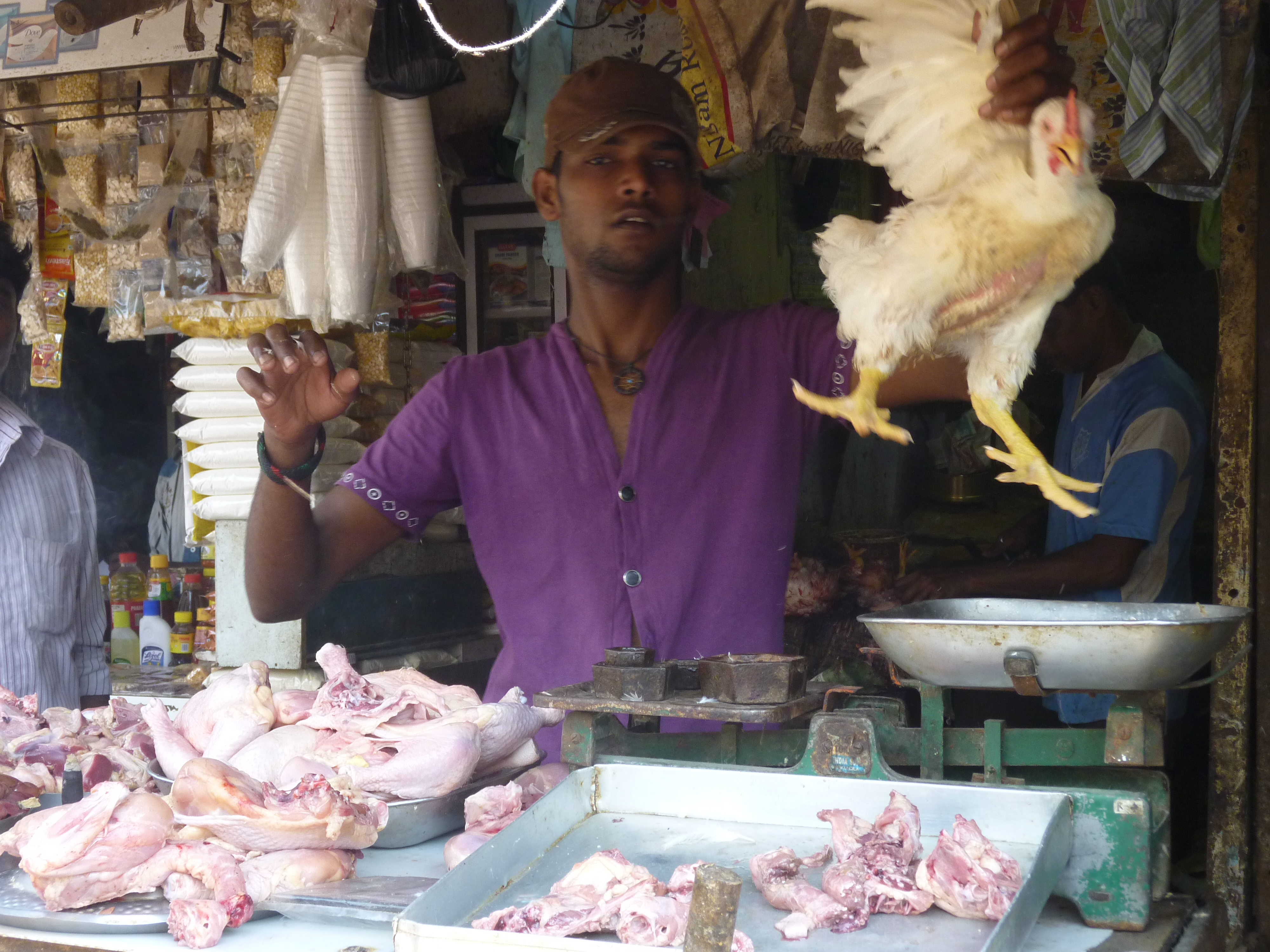
What was not amazing was the selling of chicken…. Half dead, they seemed to me, stuck in horrible cages, awaiting their destiny. People would pick one, the stall keeper would drag it out, put it on the scale and showel it over his shoulder for the next guy – who slit its throat. Hygiene seemed to be nowhere around… I just had to stand there for a while and watch. Surely I would be nowhere close to a chicken for the rest of the journey!

Made a big impact on me.....


My very special colour combination… July 9, 2010

Is it possible to fall in love with a colour combination? Well yes…. But I am in fact a bit shameful to say that it was the Norwegian princess Märtha Louise who brought my attention to the combination of brown and turquoise. She was wearing a dress some years back, can’t remember the details any longer – only the colours! I thought it was an unusual combination, but I got hooked. And – the hunt was on! But I realised I needed a bit of luck. Shops do not swell with brown and turquoise!

I always find what I look for, in India…. In 2009  I visited designer  Geetha Hardasani’s shop in Bandra, Mumbai. When Ida and I visited Mumbai in 2008, we visited her shop, at that time in Colaba. I kept in touch with Jharna, the designer’s daughter, and thus made sure to pay their new shop in Bandra a visit in 2009. I saw the kurta only seconds after I entered the shop. Wow – something brown and turquoise. Before the others had managed to manouvre themselves inside, I was dressed in…. brown and turquoise… And – sold!

I almost spotted this one from outside the Hardasani shop....

I wanted to buy a designer made outfit; a kurta, churidar and dupatta – and went searching through Geeta’s rows of fabric. I chose the best one, the most expensive one (!) with a fantastic dupatta made of a variety of fabric. But the embroidery on the kurta had the colours of…. brown and turquoise…

My designer made wedding outfit!

Close up of the kurta.


In 2009 Asbjørn and I went to Delhi and one day, strolling through the arcades of Connaught Place I saw it from a distance, a tunic of – yes – brown and turquoise. It was only one left, my size, which proves it was meant for me!

Bought at Connaught Place in Delhi, photograph taken somewhere around the Fort in old Delhi. A young girl wanted her photo together with a farangi...

It’s not so hard to find jewelry in the colours of brown and turquoise. Maybe because of the stone itself, the turquoise…. Moreover, I can’t be the only one in the world thinking that this is a great combination!
My favourite bracelet is bought at Arts and Crafts (Norwegian brand), and people often comment on it. But a while back I was thinking; it must be possible to make jewelry by oneself?!!? So I took a course at a bead shop and learnt some tricks… I’m not going to make a home industry out of it, but it’s nice to be able to make something when inspiration hits you…. Beads do not come very cheap in Norway, what I’m now looking forward to is my travel to India later this year. Shopping for beads in Mumbai….. Must be some treat!

Three strands of beads made by myself, beads and colours carefully picked....

These - my favourite bracelets - have everything that I like; the beads, the colours, the antique look...


Last summer our grandhild Claus, now aged 10, known for his high level of justice, realised that everybody had gotten a summer’s gift  except from granddad… He had seen something suitable though, in a shop in Stavanger…. So Asbjørn and I were left to wait in a cafe, whereas he dragged his mother to Ting and bought a case for toothpicks – and what’s more; the colours were brown and turquoise. The young man was very proud of himself; not only was it the perfect present for Asbjørn who can’t live without toothpicks, but the colour combination was such that Anne-Trine could enjoy as well! He proudly stated. A 10-year old to be proud of!

A perfect hiding place for tooth picks!


So many trees…. May 4, 2010

Filed under: Indian literature — benjamuna @ 3:38 pm
Tags: , , , , , ,

I don’t really recall the first time I read about the Banyan tree, but it was definately in a novel. And definately I understood it had absolutely nothing to do with bananas…. I got the feeling the tree had some significance, and that it was big! The first time I actually saw one, was in Pune some years back. My friends Girish, Sanjay and Mandar took me to the University of Pune, and I asked them to look one up for me, in the huge surrounding garden.

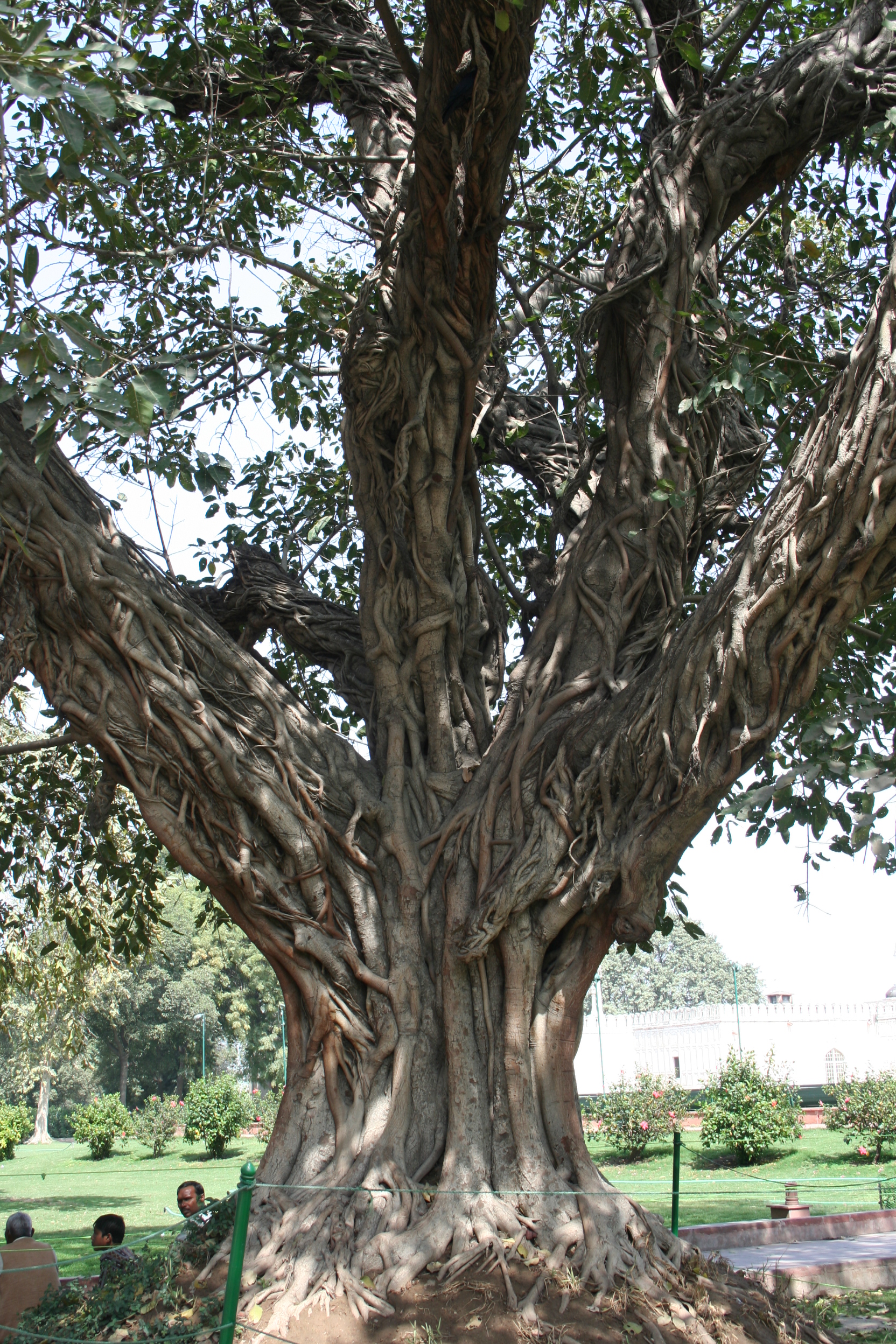
The Banyan tree (Ficus bengalensis) is sacred to the Hindus and is often found near temples. It is extremely long-lived,  one of the the oldest one – of 400 years – can be found in Kolkata Botanical Gardens. Yes, it’s big and not at all attractive in the sense of elegance…, but the aerial roots that decends to the ground from the branches gives it a  fairy tale look and also a very distinct look.
I often come across the Banyan tree in novels, very often described as big, and yes, it often grows to a phenomenal size.  I’m always on the look out for a Banyan, the first Indian tree I got to know.

A Banyan tree in the surrounding gardens of The Red Fort in Delhi.

Another tree which I have come across in many novels, is the Neem (Azadirachta indica). Its more elegant than the Banyan and very popular because of its medical value. Neem twigs can be used as a tootbrush, where plastic yet has not enveloped the society.  This is something often referred to in Indian novels, used mostly among poor people.
The first time I really saw a Neem was outside the gates of Taj Mahal in Agra. The Taj Mahal was grand and beautiful, but it takes some effort to visit one of the world’s seven wonders…and thus it was a bit of a relief when we escaped the guide….and my eyes fell on the big and beautiful tree that stood majestetically in the middle of a square. A beautiful Neem.

A Neem outside the gates of the Taj Mahal in Agra.

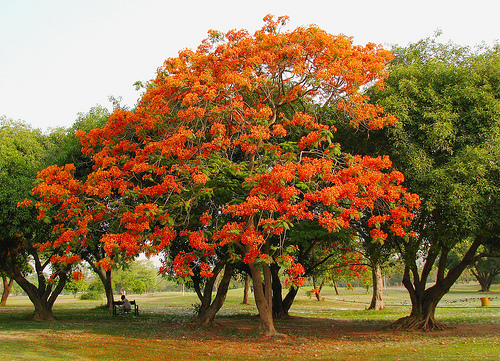
I fell in love with the banyan the moment I saw it, but it is quite possible to fall in love with the name of a tree….. The first time I read about the Gulmohar (Delonix regia), it was the name itself that caught my attention. Gulmohar or Gul mohur as I have also seen it written. 
Gulmohar is the name of a character in The Peacock Throne by Sujit Saraf. She is one of the whores on GB Road in Delhi. “It’s a flower, the bai said to her. It will make people swoon over you to catch the whiff of your fragrance“. Gulmohar comes from Nepal, snatched away from her hometown by her uncle Jangbahadur to serve as a whore in Delhi at the age of 16… The book is a terrific read, set in old Delhi and its main thoroughfare Chandni Chowk.

Somehow I associated the name Gulmohar with yellow… I envisaged a tree with yellow flowers. Obviously because “gul” in Norwegian means yellow. The tree has in fact beautiful orange/red/vermillion flowers. Its flowering season in India is April – June, a time of the year of which I don’t go to India. But my great wish is to see one, in full bloom! And for sure I will think of poor Gulmohar in GB Road!

Google helped me find this beautiful specimen!


Getting my Hindi right! April 25, 2010

Filed under: Indian literature — benjamuna @ 3:32 pm
Tags: , ,

I know how to swear in Hindi! Not that it is important, although you never know when certain words may become useful…. For some reason almost all novels, written by Indian authors – includes a lot of words that are not translated, but kept in Hindi. Some books even include a glossary.

One of the first words I came across, was charpoi. Clearly it was something to lie down on, a simple bed (without any mattress) – often used outside. The first time I saw a charpoi, outside a dhaba north of Delhi, I instinctly knew what I saw.  And a dhaba? Clearly some kind of eatery (I concluded the first time I came across the word,) – along the road. Used by truck drivers and other passers by. But in the beginning I thought a dhaba was very poor and simple. It is simple yes, and most of the time (from what I’ve now seen) chairs and tables are outside. Toilet conditions can be a challenge, for over-hygenical Westernes….
Some say the food is poor. I guess it can be poor, sometimes. But go and eat at the Norwegian equivalent, the veikro, and food can be disastrous!  I had the most delicious, hot tomato soup in a dhaba last year. So fantastic that we had to stop at the same dhaba on our way back to Delhi several days later.

And there is the dhobis (who wash clothes), the dupatta (female shawl), and the dacoits who might rob your train through Bihar…. And the almirah (chest of drawers or cabinet   ) and the ayah (the live in baby sitter) – and the wallah, the tiffin, the sherwani, the mangalsutra, the ghats and women in purdah…. together in their zenana.
Not to mention that always-come-useful word accha.

Obviously, every one of these words cannot be translated easily into one word. But some can, without doubt. But it is as if a certain collection of words are never translated anyway. It’s a long time since I have come across a new word, though. I read Indian literature almost constantly, and my vocabulary that has been picked up from novels seems to have hit the roof. Sometimes I wonder if there exists a small hidden book somewhere, that contains the “untranslatable words of Hindi….”

All these original words definately give the books a certain Indian flavour, and if you have an interest in languages it is a big bonus! But I don’t think I’m able – yet – to strike up a conversation in Hindi by using this diverse lot of words…..
Oh, and the swearing comes almost solemnly from Vikram Chandra’s fantastic novel Sacred Games – about policeman Sartaj Singh,  criminal overlord Ganesh Gaitonde, a Bollywood film star…. but on second thoughts I’m not going into that!

And something more about Indian novels; they made me put a book of Indian trees on my wish-list for last Christmas. But that’s another story….


Rushdie & me… April 21, 2010

Filed under: Indian literature — benjamuna @ 6:39 pm
Tags: , , ,

Time to read Salman Rushdie. After three years with various known and unknown Indian authors, I somehow thought it was high time to read Rushdie. Or was it maybe because I was moving my Indian book collection to one designated shelf, and came across Midnight’s Children. The book tells the story about a boy who was born quote Nehru: “At the stroke of midninght hour, when the world sleeps, India will come to life and freedom.”In other words, 14 August 1947 – at midnight. I guess it was this historic touch that made me keep the book out of the book shelf, because stories centered around the Partition are always triggers my curiosity! And moreover, when it comes to India I believe in faith. I didn’t find the book, the book found me! As happened before…. (Geethia remembered…)

But – disaster struck….. I read approximately 50 pages and I didn’t understand anything. Vocabulary…. syntax….. story…. No. I read almost all books in the English language, but this was quite a nutcracker.
My bookshelves are deep though, and by chance I found a Norwegian edition. Must have been bought long time ago, a 1989 edition and the price tag says 45 kroner. Some bargain.
Again. The book came to me!

After a few pages I realised why I wasn’t able to decode the English edition. The language is not average even in Norwegian, nothing is average in this book. You have to think hard as you go. And being familiar with Indian history isn’t exactly a drawback!
Who’s voice is it now…. where are we…. what happens really now? Two stories simultaneously. It’s crazy. Witty. We are in Kashmir. Agra. Delhi (even in Chandni Chowk!!), and then Mumbai where Saleem is born. We’re in “Muslim-India”.

So far it’s a slow read. I’m not half way yet, but this might be one of those books who could last for ever!


Raigad/Pen revisited…. November 24, 2009

Filed under: INDIA — benjamuna @ 5:40 pm
Tags: , , ,

Yesterday was again very busy… Sandeep from Childrens Future India (CFI) came with the car to our hotel in Mumbai; Pen next… Of course we all + the luggage, didn’t fit into the car. We tried a million variations and everybody shifted place several times. Luggage up and down from the top of the car. The ususal India hullabaloo… End of story: Sandeep had to take a taxi with our luggage… hmmmmm. And we haven’t started shopping yet!!

But we arrived in CFI’s office only an hour after schedule and I met Dr Deshmuk who runs the CFI office in Raigad, and whom I met in Oslo some weeks ago. We were greeted with the usual flower garlands and then the rush started; presentations, tour of the office etc, before going out to meet my new sponsored child Seema and her family. They live in a small village, aprox 20 family members in the house. After a while I realised we were not only  people in the house, but two oxens as well…The family is very poor, Seema has three sisters and a brother. Father is not able to work because of something is wrong with his foot. The mother was so tiny I can’t understand she has been able to give birth to five children. Afterwards we visited Seema’s village school where we were placed on the ususal plastic chairs up front….

But what made the biggest impression on us, was the visit we made to a young widow with three children. Her brother had helped her buy a small house and CFI recently helped her get a door for the house so she would feel more secure. Widows in India lives a poor life. Her small house was without electricity and furniture, only some kitchen utensils and one kerosene lamp. We gave the soscial workers money so that the family could get groceries for approx 6 months. We were all very quiet when we left, the visit had made a great impact on us.

We had lunch at the CFI office, and afterwards we visited a small hospital. The head doctor came from the slums, she was once a poor child, sponsored from Norway through CFI. Now she is a doctor…

We all felt extremely tired when we set out for Pune, but traffic was not too bad so we reached before 8 pm. We felt drenched, and full of impressions. Food and Kingfisher was the only solution………


First leg – Frankfurt November 21, 2009

Filed under: INDIA — benjamuna @ 8:38 am
Tags: ,

We have reached Frankfurt by early morning flight! For the first time I’m travelling with a PC, so the first thing I was searching for was something wireless…. Found and paid online! Still some hrs to go before boarding for Mumbai. No rush……. JAI HO!