Benjamuna's Blog

Stories…. with a touch of India….

Kumartuli – the pottery district of Calcutta March 3, 2025

Filed under: INDIA,Travels — benjamuna @ 1:59 pm
Tags: , , , , , , , ,

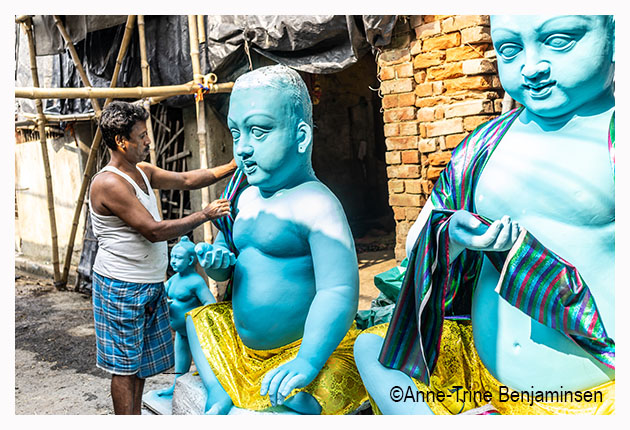
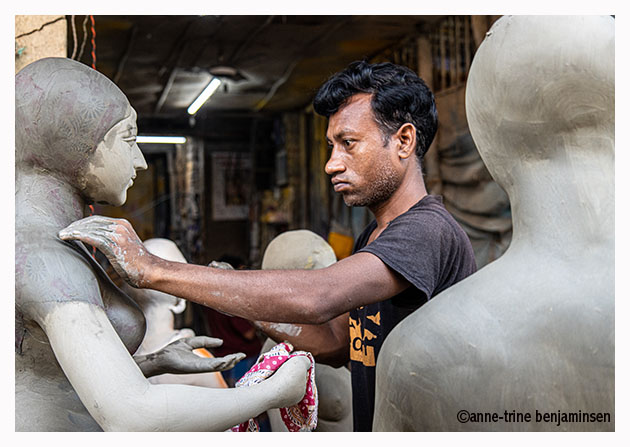
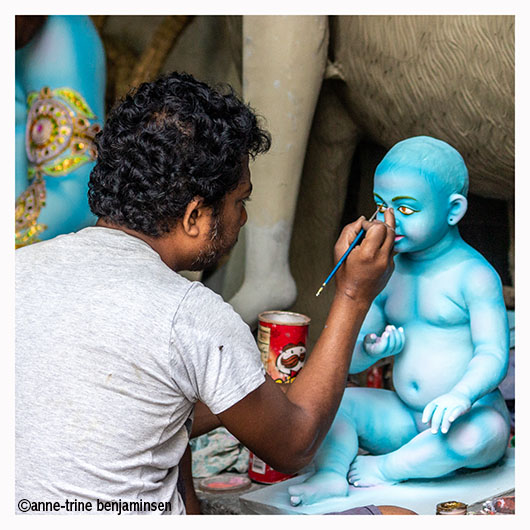
The lanes of Kumartuli is a must if you’re visiting Calcutta – or Kolkata as is the city’s official name. This is where potters make idols – not only objects of religious importance but also symbols of Bengali culture.

I have been there several times and enjoyed the handicraft being carried out. Even though I have come across a female artisans, they have mostly been men.

Kumartuli is a village within the vast city of Calcutta and found in North Calcutta, close to river Hooghly. It’s a fascinating area, it is like stepping into another time. Except from the omnipresent smart phone …

Kumartuli, also known as Coomartolly, dates back to the Colonial Era when districts were divided based on occupation – such as Suriparah (wine sellers), Collohtollah (oilmen), Chuttarparah (carpenters), Aheeritollah (cowherds) and Coomartolly (potters).
That’s how the potter’s district came into existence.

The artistic work is based on eco-friendly natural clay, bamboo, dry straw, mud, and soil. Thousands of idols are created for the Hindu festivals. The process involves careful molding, sculpting, and painting of the idols and the tradition has been passed down through generations.

The festival of Durga Puja takes place every September/October. It is an important festival which is dedicated to the Hindu goddess Durga. For this, idols are in high demand. For the potters, who depend on idol making to secure their income, the festival is extremely important.


Feathers at Free School Street June 28, 2023

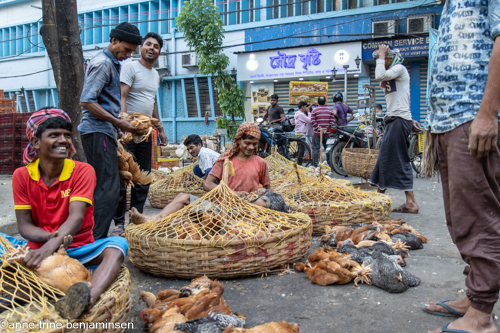
On my very first visit to Calcutta I found myself in a car driving through a street lined with cross-legged men in front of big, flat wicker baskets with chickens. I had no idea about the lay-out of Calcutta and I couldn’t ask the driver to stop, but I made a mental note of the sight and promised myself to come back. This spring, while planning a photo excursion in Calcutta, I tried to explain my to-be guide, Manjit, what I had seen. – Ha ha, he said, I know what you saw. I’ll take you there.
And he took me to Free School Street.

We set out in the early morning, 6 am to be precise. I had no idea that Free School Street was so close to my lodgings and made another mental note later that day: I could easily walk back another day and watch the whole ‘show’ again. In the wee hours the street was bustling with life, but not crowded. Come to think of it now, I didn’t see a single woman among men of all ages doing the same job: bundling up hens.

At first, I thought the chickens were dead, it wasn’t particularly lively in the wicker baskets. Some were covered by nets, but the chickens didn’t seem like they were about to fly the scene. The men didn’t mind my presence, maybe because of Manjit who constantly stroke up conversations with people who seemed to know his face. I knew I was observing daily life in Calcutta, this was not some kind of a zoo. If the men had found me and my camera intruding, it was their right.

I was appalled by the sight though, that was – I shan’t deny it – very pleasing to the camera lens, otherwise not. The men collected the chickens in pairs of twos and instead of placing them on the ground less than an arm length away they simply threw them on the ground. The chickens landed with a smack.

So that was their next station, now waiting to be picked up by buyers that either came by taxi or – for the most part – by bicycle or any other simple vehicle. Some bicycles became so loaded with chickens it was barely enough space for somebody to jump on.

The ride through the city would be the animals’ last journey, still very much alive (but not exactly kicking), hanging from their feet, watching the world upside down – if they ever noticed. They would reach their final destination, like a wholesale market or a shop, a restaurant or a hotel, as fresh as they could be.

I have seen enough in India to make me a vegetarian the minute I enter the country, sad to say. Not only as a matter of principle; the sight of Free School Street goes against anything I feel about animal welfare. But although many tourists eat well in India and tolerate the food without any problems, the hygiene is sometimes a far cry from homely hygiene measures and one should take precautions to stay away from the dreaded ‘Dehli belly’. Still, this is the way things work and this is how many people earn a living.

I spent at least a couple of hours taking in the atmosphere while walking slowly towards the end of the street. More and more bicycles entered the scene, deals were done, money exchanged – and the men pedalled away with their load.

I noticed a man hanging his clothes to dry on a clothesline on the blue wall behind him. Wearing a checked, blue lungi he seemed to have dressed for the occasion; the matching colours acted like a magnet to my camera. His wicker baskets were empty, instead his chickens lay in two heaps on the pavement. They didn’t stir, but kept their heads high. As if keeping their dignity alive to the bitter end.

It was a few days later that I discovered how close Free School Street was to my lodgings in Auckland Square. After a visit to the New Market (where the destiny of some of the hens was relieved to me in a spectacle of feathers and blood) I had been told to walk Free School Street all the way up to Park Street and I would then find myself more or less ‘at home’. At noon, the street looked nothing like the 6 o’clock sights when I had to kneel to get the best shots. Normality prevailed, people were walking on the pavements instead of smacking hens towards the asphalt. I could never have told that it was the same street.
END

PHOTOGRAPHY TIPS: I spent eight hours in the company of calcuttaphototours


Murals in Mahim February 14, 2023

Filed under: INDIA,Travels — benjamuna @ 11:52 am
Tags: , , , , , , , ,

Mahim East is perhaps not an area in Mumbai that attracts tourists in hordes. As the train approaches Mahim Junction, I’m struck by the extreme and poor settlements along the railway line and the amount of garbage is overwhelming.

Mahim East is also home to Dharavi, for many years known as Asia’s largest slum. Slum is a broad term and not always about poverty, but also entrepreneurship and – surprisingly for many – wealth, as in parts of Dharavi. The way people choose to live doesn’t always reflect their general standard of life.

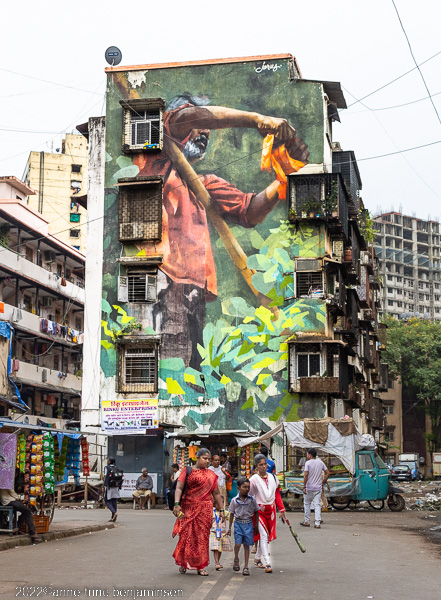
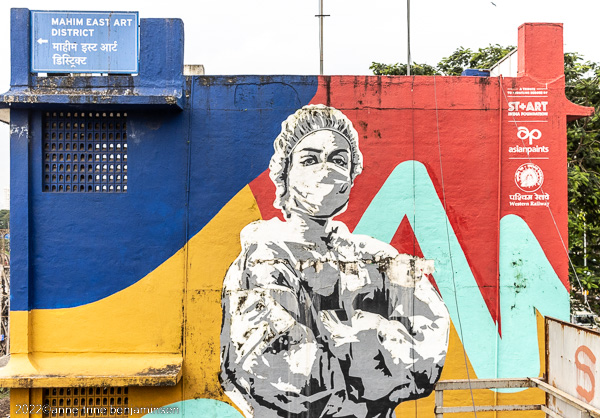
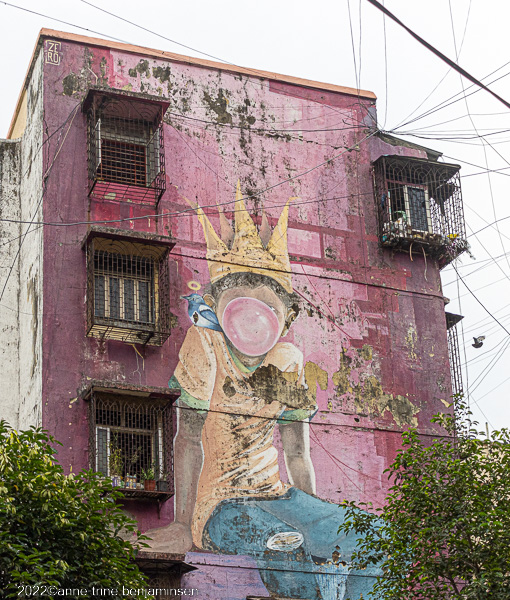
We are on our way to Mahim to look at street art, largely huge murals in strong colours and vigorous expressions. We walk around with our necks bent towards the sky to be sure not to miss anything, and we admire what we see.

What primarily characterizes the murals is their size. Entire end-walls of many buildings are covered with colourful drawings and you must have a good wide angle on your camera to capture it all. Over the years, the rainy season has been putting its mark on the buildings’ facades. The rain, mixed with pollution, has mixed new lines into the art and given it a completely new texture.

The Mahim Junction railway station is entirely devoted to the pandemic and the paintings go by the name ‘covid fighters’. As long as these paintings remain, it will be difficult to forget these years.

Mahim East, like so many other districts in Mumbai, is almost a city of its own. The lower middle class as we know it in India lives and works here, and the district is partly characterized by poverty. The large murals are part of a project that wants to beautify the decrepit expression of the district and many different artists, including foreign ones, have contributed.

Some tour guides will take you to Mahim East as part of a visit to Dharavi.

The Zamorin of Bombay took me to Mahim East.


Sassoon Docks of Mumbai March 1, 2022

Filed under: INDIA,Travels — benjamuna @ 10:43 am
Tags: , , , , , , , , , , , ,

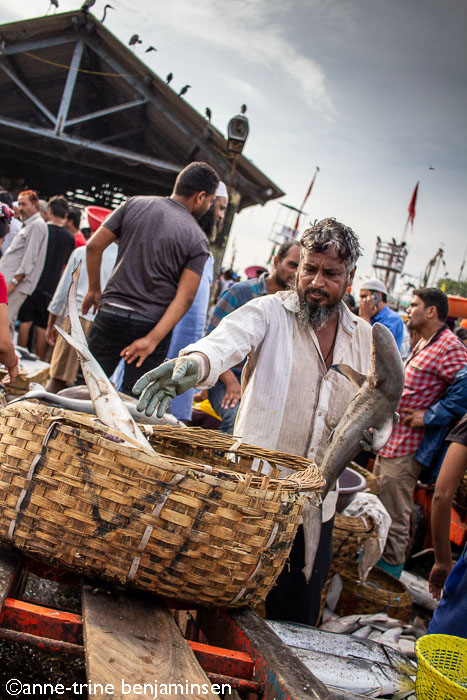
“That’s where they landed, the terrorists who attacked The Taj Mahal Hotel back in 2008,” my guide cum driver says, as he points to the right towards a small bay. He asks me if I remember and I tell him that it happened on my birthday. “It’s not allowed to stop or park the car and police are always posted”, he adds.
I didn’t see any police although our car was hardly moving. But maybe I was not supposed to.
We were on our way to Sassoon Docks, another Mumbai tourist attraction in Colaba, in the very south of the megalopolis.

Several web pages had pointed out that photography was not welcomed by the workers, some pages even used the word prohibited. I ask my guide who shrugs and says he couldn’t really tell. “You never know, maybe it depends on their mood that could be marked by the catch of the day,” he says without enthusiasm. It was clear that he wouldn’t be of any help. I tell myself to be polite, and not too intrusive.

Sassoon Docks, built in 1875, is one of the oldest docks in Mumbai and was the first wet-dock constructed in Bombay. It is also one of the few docks in the city open to the public. According to The Maritime History Society of Mumbai, the Sassoon Dock was formally inaugurated on Tuesday, 8th June 1875. The Times of India dated 09 June 1875, in an article titled ‘The Colaba Sassoon Dock’, describes the dock in the following words: “The dock is about 690 feet in length, 300 feet in breadth, 40 feet from gate to gate, has therefore an area of about 195,000 square feet, and has a 15.4 fill below the wear tide. A substantial stone bunder encloses the dock; and flood gates are provided at the entrance on the east side.”
The docks were built by David Sassoon and Co., a banking and mercantile company which was run by David Sassoon’s son at the time. The dock is no longer in private hands, that happened years ago.

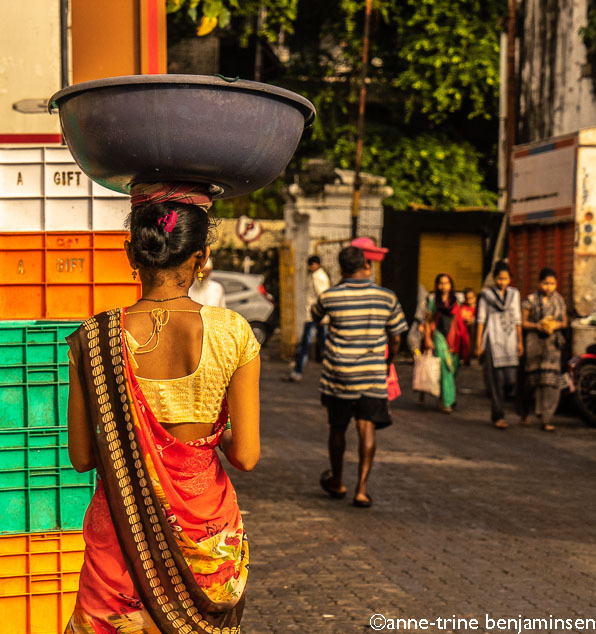
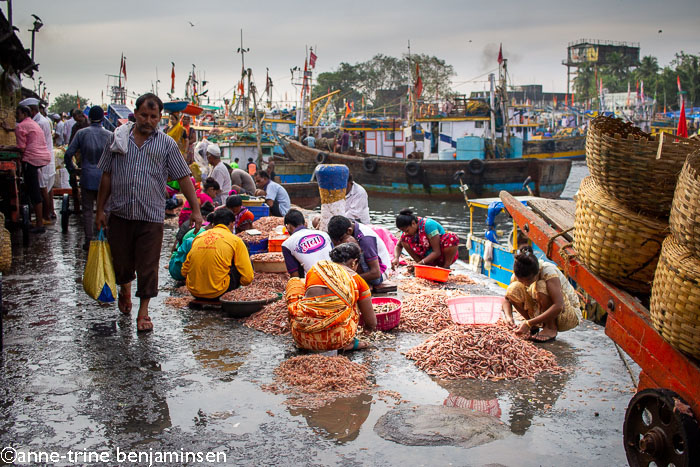
We walk through the big gates and head towards the quay while trying to avoid lorries, busy men with hand-carts and the many puddles of water. More men are working outside the ramshackle buildings, while beautiful women in their immaculate working attire – a beautiful sari – are sailing past us, bowls on their heads.
I had braced myself for the smell of fish, it had been raining and the sky was painted grey. But as always in India: colours prevail. From the shining yellow boots worn by men shuffling ice, to the bright orange and blue plastic crates, the colourful trucks and boats – and again, the women in colourful saris.

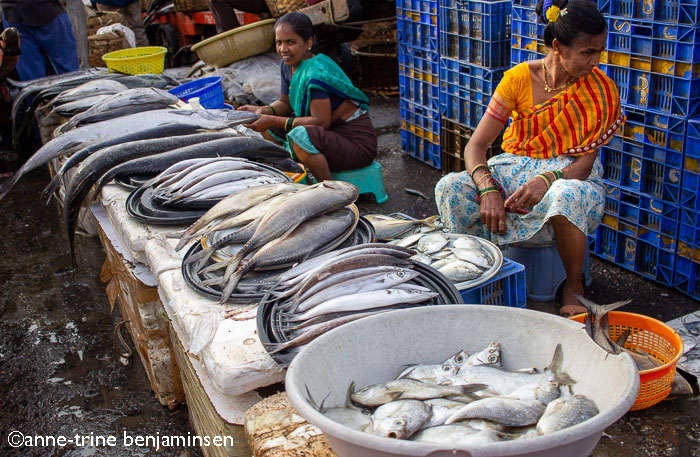
The fishing boats lay shoulder by shoulder, row upon row, in the water that seems to glister with oil. They look wrecked, like a colony of sinking ships. Everywhere around us, men and women rest on plastic chairs or on the ground in front of fish unknown to me. But as I later knew would be pomfret, Indian red snapper, cuttlefish, swordfish, stingrays and shrimps. Baskets, bowls, crates – many types of storage were lying carelessly around – or placed on top of somebody’s head. The whole place is bustling, and I make it a point not to be in anybody’s way.

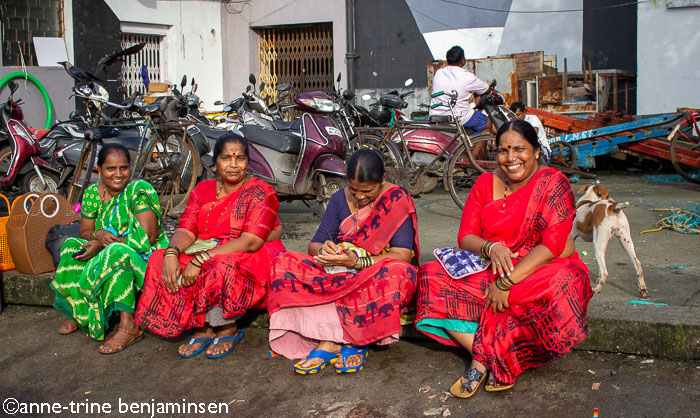
The fisheries are run by the Kolis, a group of people who helped develop the harbours and coastlines of Mumbai back in the days when the city was named Bombay, a scattered amalgamation of seven islands. The Kolis live in Koliwadas, modest quarters of the city, distinguished from the rest of Mumbai in their traditions and social life. I had read that the women, in particular, were aggressive and prone to shouting at tourists – especially those with cameras. I experience no such thing; the women are either smiling or busy with their work.

I sneak around, trying to make myself invisible. My guide seems uncomfortable, it’s obvious that he wants to avoid any form of provocation, I am after all his responsibility – for the time being. But nobody seems to pay me any attention, the shrewd Koli women have more important things on their mind. While the men catch the fish, it is the women who sell the catch and thus are responsible for the family economy.

It’s getting warmer and the overall stench seems more persistent. The guide is ready to leave and I tug along. As he turns the car and starts to drive towards the north, he points at some shacks and tells me that many of their residents earn their living from the docks.  “They’re not poor,” he says, “although it might look like a slum. Inside these shacks you’ll find millions of rupees in cash, and gold. But this is how they prefer to live.”
It could be the truth, or part of the truth, but possibly also a myth – popular among guides.
If Sassoon Docks will outlive further urbanisation of Mumbai remains to see, so don’t miss it should you get the chance!
More photos:


The big laundry February 21, 2022

Filed under: INDIA,Travels — benjamuna @ 2:58 pm
Tags: , , ,

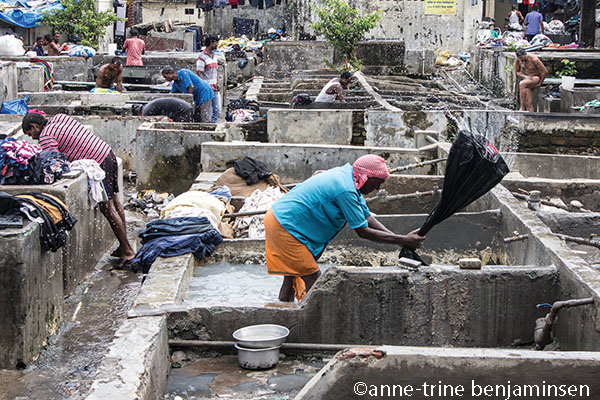
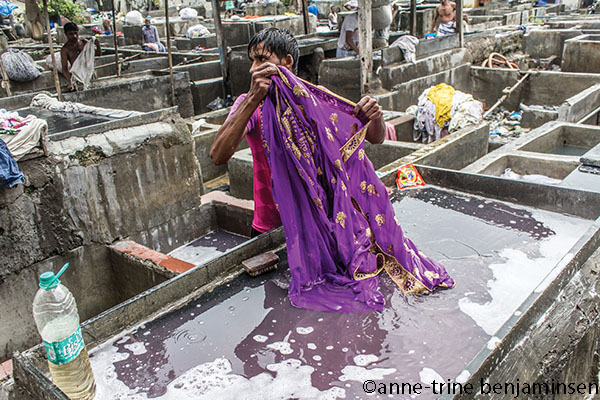
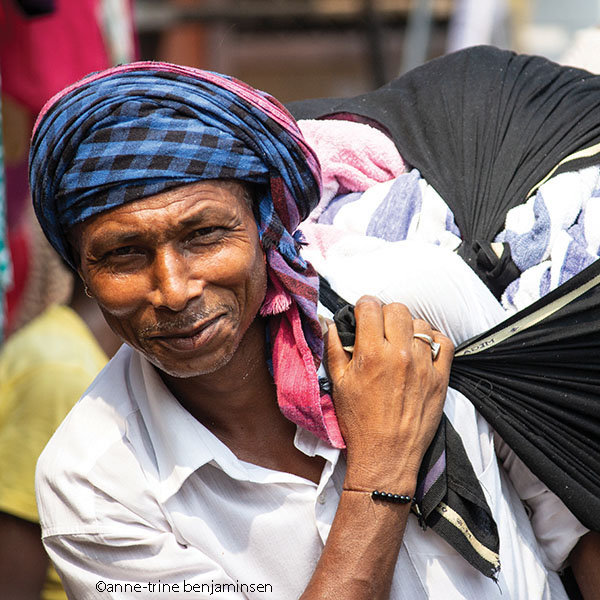
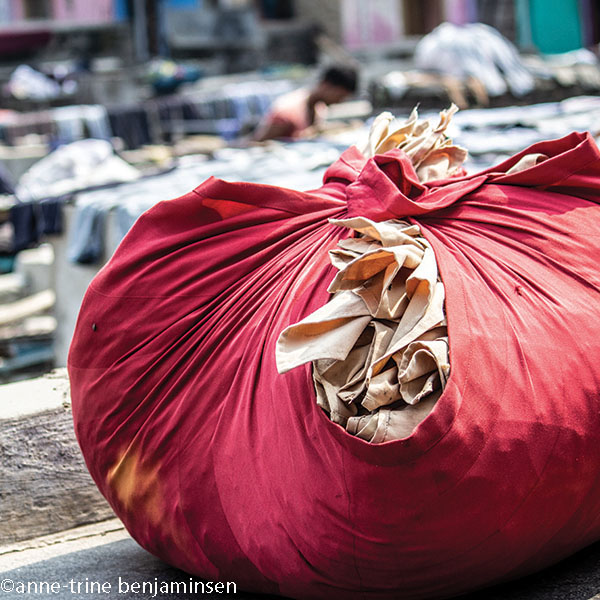
The air is hot and humid. Sweat is trickling down my spine and my sandals draw water.  I sneak through a narrow passage to the sound of clapping feet running back and forth. Loud voices come with violent outbursts and I get a feeling of being in the way. Large knots of dirty clothes hang heavily over the shoulders of the men, and every now and then I see a woman with a knot on her head. We are visiting an open-air laundry in Colaba, in the south of Mumbai. A dhobi ghat.

Tourist attraction
A little further north, Mahalaxmi Dhobi Ghat is still one of the city’s biggest tourist attractions, although the laundry has been predicted to close for many years. The area is attractive to large developers who believe this type of laundry belongs to the past.
The laundry was established in 1890 and has been presented in The Guinness Book of Records (2011) as the world’s largest open-air laundry. From the large bridge at Mahalaxmi Railway Station you get a good overview of a damp and crawling ‘anthill’ where, at the most and once, close to a thousand washermen, called dhobis, simultaneously earned a living.

Dirty clothes are primarily delivered from hotels and hospitals. The area is divided into wash pens, each fitted with its own flogging stone. It might not be the place where I’d send my summer dress.

Inherited profession
The dhobis have to pay rent for each washing pen to the Mumbai authorities. In a society still plagued by corruption, they must expect to be exposed to money collectors who ask for bribes in order to renew leases on behalf of the authorities.

The profession of a dhobi is hard and passed down from generation to generation. Mahalaxmi Dhobi Ghat spans many blocks and is seen as urban slum. Here, the dhobis live with their families in very poor conditions, and child labour is not uncommon. After all, many are born into the profession.

Dhobi ghat in the south
We chose to visit a smaller and more unknown dhobi ghat in Colaba, the far south of Mumbai. Here you can get closer, and walk unnoticed between busy men, giggling children and the ubiquitous stray dogs. Although a dhobi ghat is characterized by manual labour, there are a few large electrically powered centrifuges under cover.

Large, white or colourful sheets mixed with worn jeans hang to dry along the walls or on large racks on the roofs of surrounding buildings. You probably have to be a bit of an acrobat to get the laundry hung to dry! Flats, one of top of the other, painted in India’s candy colors, surround parts of the laundry and lighten up an otherwise grey area.
It is the middle of the day and the activity is low. Most of the work takes place early in the morning so that washing can hang to dry throughout the day. Here, there is no computer or app that registers washing in and out, but a coding system that keeps track of customers and laundry. We notice how some of the men soap themselves and shower with water from a bucket. A few minutes of respite breaks up a tough daily life – mostly about soap and water anyway.

WHERE: Dhobi Ghat off Capt. Prakash Petha Marg, Colaba


South Park Street Cemetery March 25, 2021

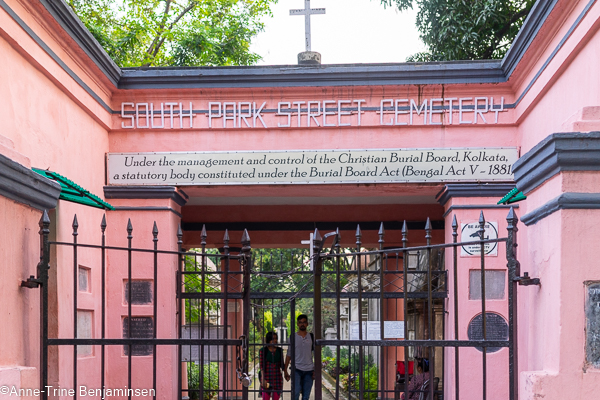
“You should go to the cemetery,” a photographer in Kolkata once told me. “No, you must go, he added. “You’re staying just around the corner.” So I went there.

Kolkata, or Calcutta – a name with much more history attached to it, is like any other Indian city of a certain size, a beast. Crowded, noisy, confusing, at times heavily polluted. The moment I walked through the gate of the cemetery, I found peace. And now, reminiscing about my visit, I come to think of the title of an old pop song from the 60’s, ‘Graveyard Paradise’.

Photography prohibited; a sign tells me. But most things are available at a price, I motioned my camera towards the guards and upon request paid 200 rupis for potentially using my camera. I was not able to understand the logic behind the fee, but the amount was small and the guards welcoming.

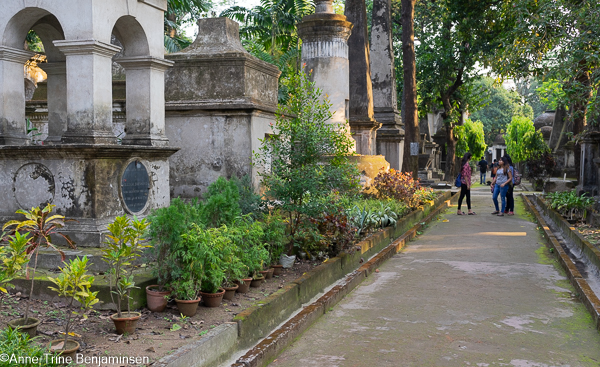
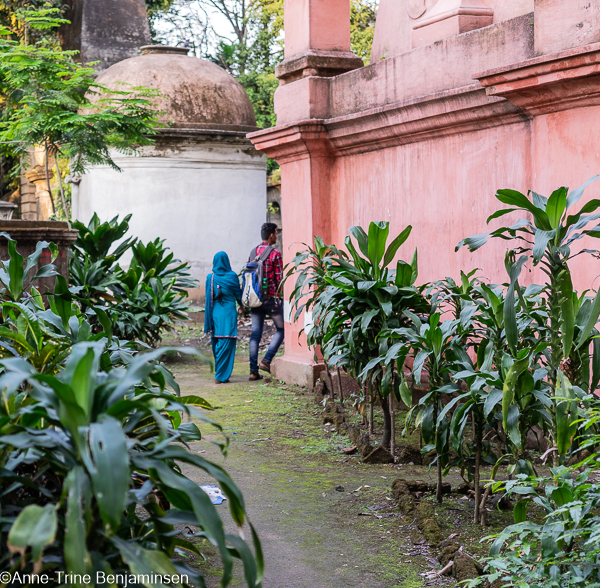
The immediate sight was overwhelming. The cemetery looked like an old, lush overgrown garden. The footpaths were flanked by weathered tombs, colonnades, mausoleums, obelisks, sarcophagi, and stone cupolas – all partly covered in moss and framed by a variety of trees, bushes and potted plants. Chirping birds made the picture complete, the traffic noise became nothing but a soft backdrop. And the whole place reeked of old history from the time of the Britishers.

This burial ground came into being in 1767, in a marshy area. To reach it, a new road had to be built – today called Park Street, and no one visits Calcutta without strolling up and down this street. But I might not have walked this far had I not known what to find …

The cemetery was in its time opened to relieve the pressure on the city’s old burial ground. It became the final resting place of the many Britishers who came to stay in India for several reasons, but many hardships had to be endured and many tombs tell stories about short lives. Tropical diseases, poor sanitation, and lack of medicines were the main reasons for all those early deaths.

Some 1600 British men, women and children are buried here, among them some notable personalities and there are quite a few military burials. The cemetery also tells stories about young women who presumably died in childbirth, as many children are buried together with their mothers.

South Park Street Cemetery covers 8 acres, and walled off from the busy streets makes it the perfect get-away for young couples. Visit any big garden or park in India, and you’ll find youngsters strolling leisurely along the footpaths, holdings hands, sitting close on benches – or they might be seen kissing and cuddling behind big tree trunks. The cemetery is no exception. I teasingly asked a young couple if I could take their picture, but they leaped up from their bench as if they had seen a … ghost!

[END of text]


The newspaper men in Calcutta March 20, 2021

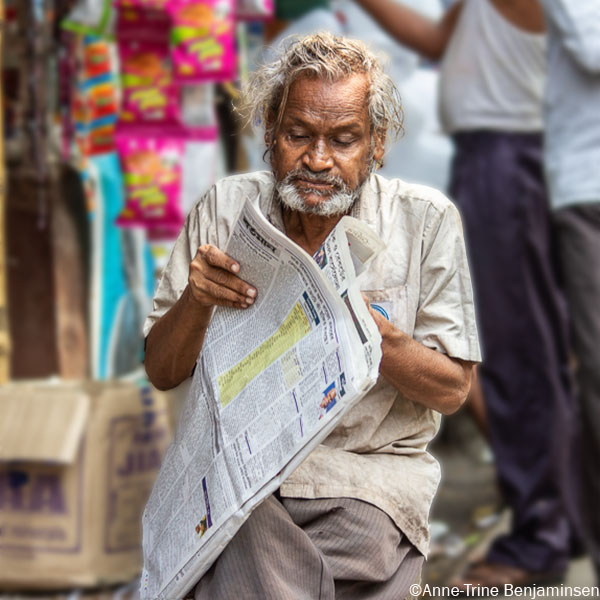
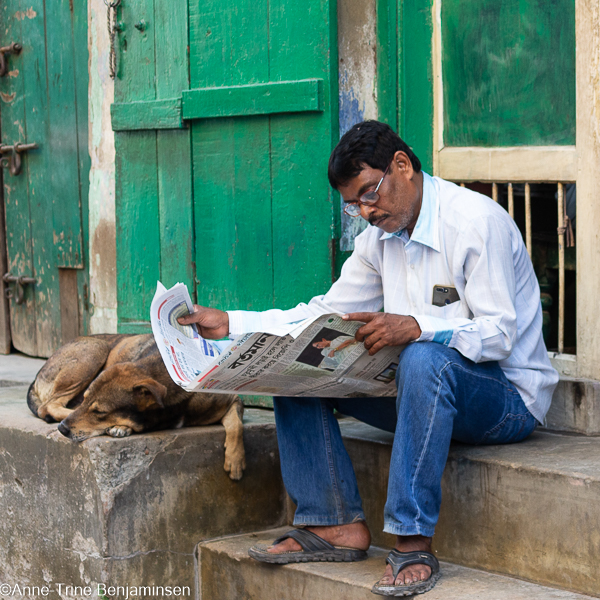
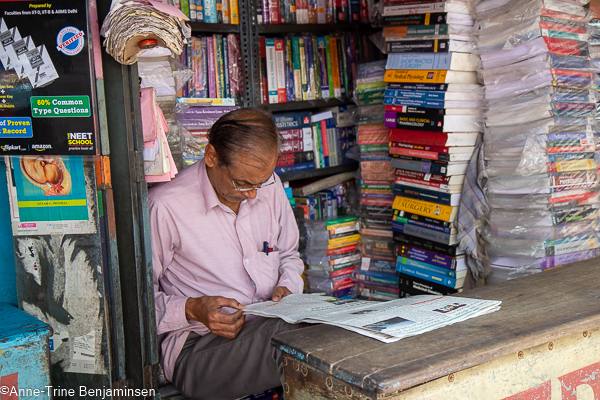
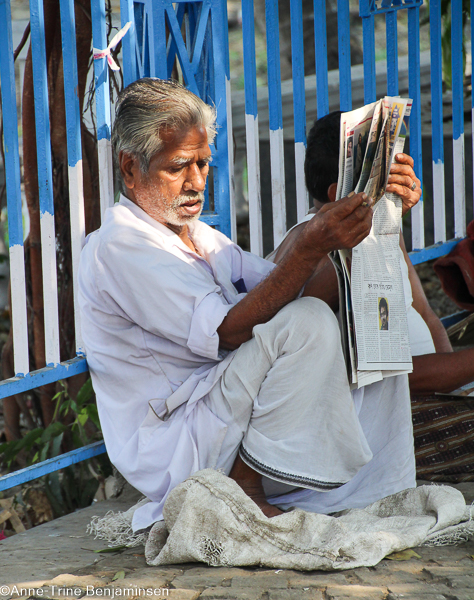
I immediately noticed them when I first came to Calcutta, and never stopped doing so: The newspaper men. To me, they are men reading newspapers on the streets, in their stalls, sitting on stools and chairs, leaning onto railings, or whatever comes their way, at bus stops – simply everywhere. Yes, there are people hunched over cellphones like everywhere else in the world, but more noticeably are those who fold out broadsheets or the likes.

“Asia’s first newspaper started in Calcutta,” says Soham Chakrabarty, founder of Calcutta Capsule. “The Hicky’s Bengal Gazette (1780) was published for two years before The East India Company seized the newspaper’s printing press. Calcutta was once home to a lot of newspapers, and some of today’s newspapers are more than a hundred years old, like The Statesman.”

A quiet moment …

While Delhi, with its grand monuments, is the capital of India, and Mumbai the financial hub, Calcutta is often seen as the cultural capital of India marked by art, literature, science, politics and journalism. Bengal, especially Calcutta, was the cradle of journalism in India and till the 1880’s the main hub of newspaper publication.

“Newspapers acted as a medium to reach out to the common crowd,” says Soham. “The independence movement, but also other political issues, included a lot of newspapers through which freedom fighters and activists voiced their opinions.”

Another quiet moment at Howrah Bridge.

Till this date I haven’t seen a single woman reading a newspaper on the streets of Calcutta. Nor are there many female street vendors.
 “The streets of Calcutta are a man’s world” says Soham. “Common culture be it, or whatever reason, do not make it comfortable for women to spend too much time on the streets hence you don’t see them reading newspapers. Whereas a lot of men do spend time on the streets, sometimes for no obvious reason, where they see it fit to read newspapers. Both my grandmothers had habits of reading newspapers. They were homemakers, but always found time to newspapers within the premises of their house.”

As I go through my Calcutta photos it comes as no surprise that the men reading newspapers aren’t exactly the young generation, rather middle-aged men who, like myself, finds pleasure in something that is about to become an anachronism. And the day I was about to finish this blog post, the newspapers didn’t show up in my mailbox on a Saturday morning; the prime newspaper day of the week. A tablet was put on the table, but no matter how hard I tried I wasn’t able to digest the electronic news together with bread and butter.
[END of story, more photos below]

My Calcutta Man!
 

Airport yearning … September 9, 2020

Filed under: INDIA,Travels — benjamuna @ 3:58 pm
Tags: , , , , ,

I never, never thought I’d miss the long and exhausting immigration queue at Mumbai, or Delhi airport. And before that, the long strides; trying to overtake other passengers when KLM and Lufthansa are emptying their big bellies at midnight. But miserably enough, the line seems endless once I reach. The straps of the rucksack with my photo gear start gnawing into my shoulders the minute I find my place, the over-sized handbag seems even heavier than when I left home although the apples are eaten – and a book doesn’t feel lighter only because it’s almost finished.
The air is thick and moist. The cardigan and wind jacket, once useful when I was waiting for the airport shuttle back home at 4 am in 8 degrees C, are now superfluous and nowhere to be stowed away. And how come the shoes seem to have shrunk so badly. I’m telling myself I’m not tired, and text a message to the homefront: Grounded.

People are moving slowly towards the immigration counters, and everybody is at one point asking the same question: Why are only x out of y counters manned? The most important question of our times, when stranded in this Godforsaken queue. And we stretch our necks and realise that the grave men behind the counters, their faces cut in stone, are still struggling with that little remedy we all have to put our finger(s) on and apparently this remedy still doesn’t go well with clammy index fingers, so in turn we all try and several times again until luck (certainly not technology) strikes. But contrary to US immigration, we are not cross-examined about our whereabouts in India, just nodded tiredly away from the counter. Thank God for small mercy’s!

Released, everybody rush through the sparkling tax free, but why would we rush to pick up the luggage when we know it’s probably still roaming the underbelly labyrinth of the airport. I grab a trolley, check the monitor and meander through the throngs of people, trolleys, luggage, loitering airport staff, and silently place myself in the middle of chaos surrounding belt 40, scanning it in the hope that my suitcase has won the lottery: already spitted out and hit the belt. Alas no. Instead the fear, no horror, of not getting the suitcase at all is what occupies my mind.

I wait politely and patiently among the unruly mass of people, text another message just to kill time: Waiting for the luggage, while I in wonder and amazement watch the amount of luggage the native Indians lift off the belt and how they make towers of king size suitcases while they’re waiting for more. And I keep thinking that Mumbai might not be their final destination and how they, past midnight, maybe after several flights from the US or Canada via Amsterdam must check in their towers again and take that dreary shuttle bus to the domestic airport. It makes me feel a little less miserable.
I cling to my trolley while waves of fatigue races through my body, and just as I give up hope my suitcase pops up – and down, and I grab it before it goes for another swing.

Nearly there, I tell myself, relieved (should I text a message?) – before another worry takes hold of my stomach as I rush towards the green channel. Why if the driver is not outside to pick me up? (I mean, it has happened once or twice, so why not a third time?)

This is what I miss right now. And I miss it badly!


Rickshaws in Calcutta March 27, 2020

Filed under: INDIA,Travels — benjamuna @ 9:11 am
Tags: , , , ,

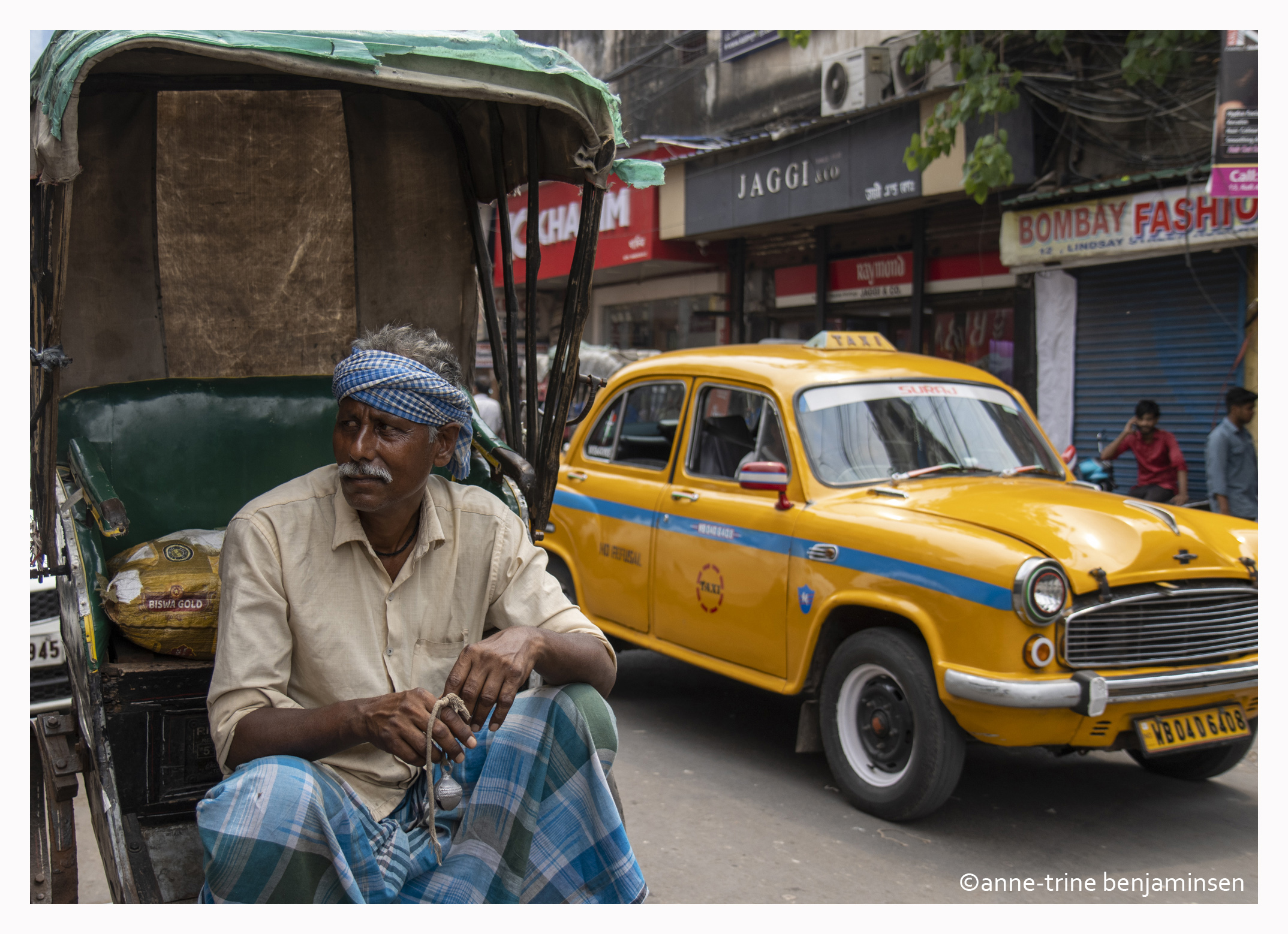
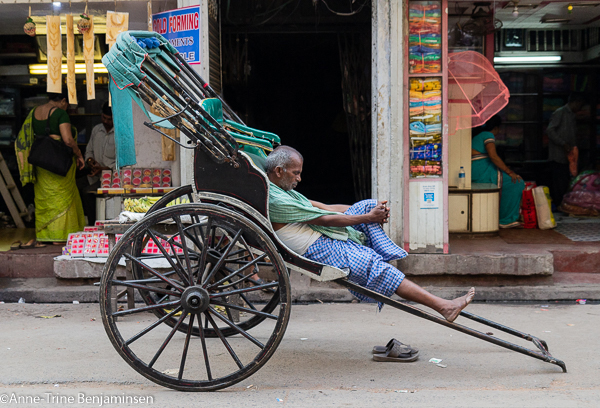
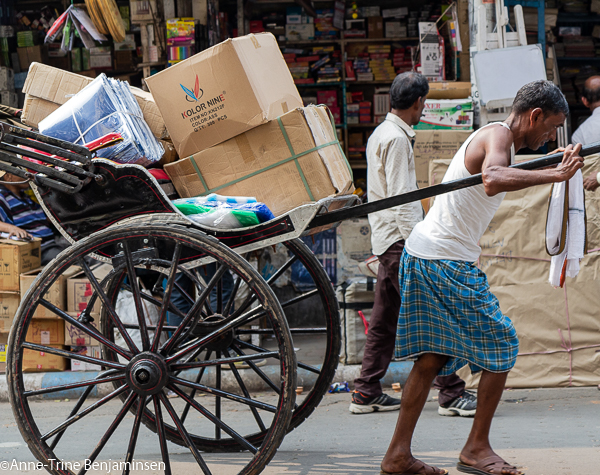
The hand pulled rickshaws are undoubtedly part of Calcutta’s (now Kolkata) DNA. They date back to colonial times and have since become an important part of Calcutta’s transportation network. People who has lived a lifetime in Calcutta, might have seem them decline in numbers. But for me, visiting Calcutta for the third time, they seem to be omnipresent, at least in some parts of the city. Pulled by thin and sinew men in checked lungis, they seem to belong more than anything else. According to a website (indianeagle), Kolkata does currently have 18,000 rickshaw pullers and 6000 rickshaws. Not all of them are licensed by the municipality.

I have been told many stories – and read them as well: The hand pulled rickshaws are slowly disappearing. Human Right’s organisations would like to ban them, for obvious reasons. The city itself would like to put a stop to them because it doesn’t look good. In a modern world, it reminds us of slavery. I have been told that rickshaw wallahs have been given a right to continue their trade until old age, or until they for other reasons are not able to work, or pass away.
But a rickshaw wallah may pass on his vehicle to his son (no women in the picture here), or other male family members, or sell it. And who would come to know, in this big and seemingly chaotic city? And should the authorities ask questions, a wad of rupees might easily solve the problem. On the other hand, people are getting more educated these days, and only those in need, or with no other option will resolve to the trade.

It can’t be denied that a hand pulled rickshaw is a practical vehicle, especially when the streets of Calcutta are flooded during the monsoon. Moreover, they work like hand in glove in the narrow lanes and alleys, – and those are many in parts of Calcutta. The rickshaws deliver goods from one place to the other, carry children to schools and take them back to homes, and carry women to nearby local markets.
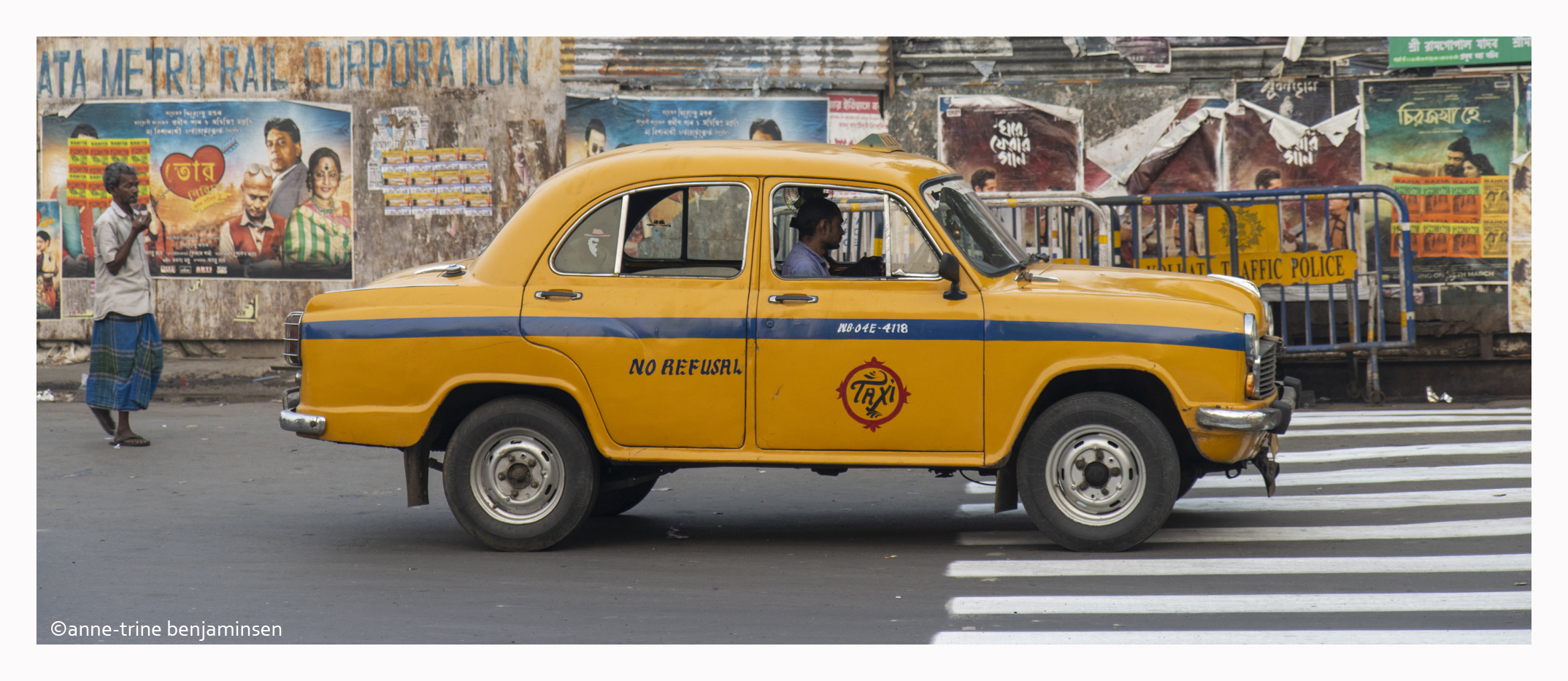
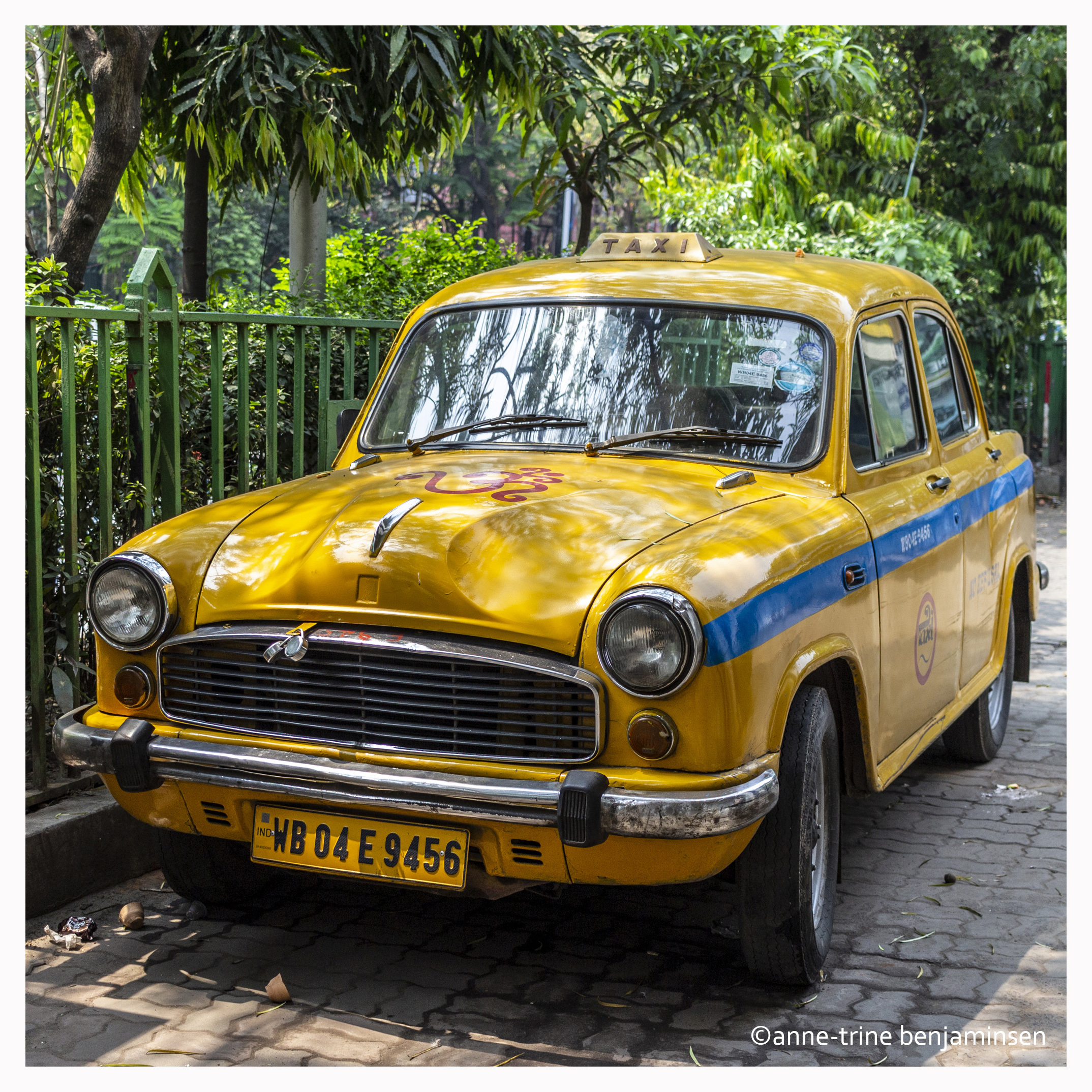
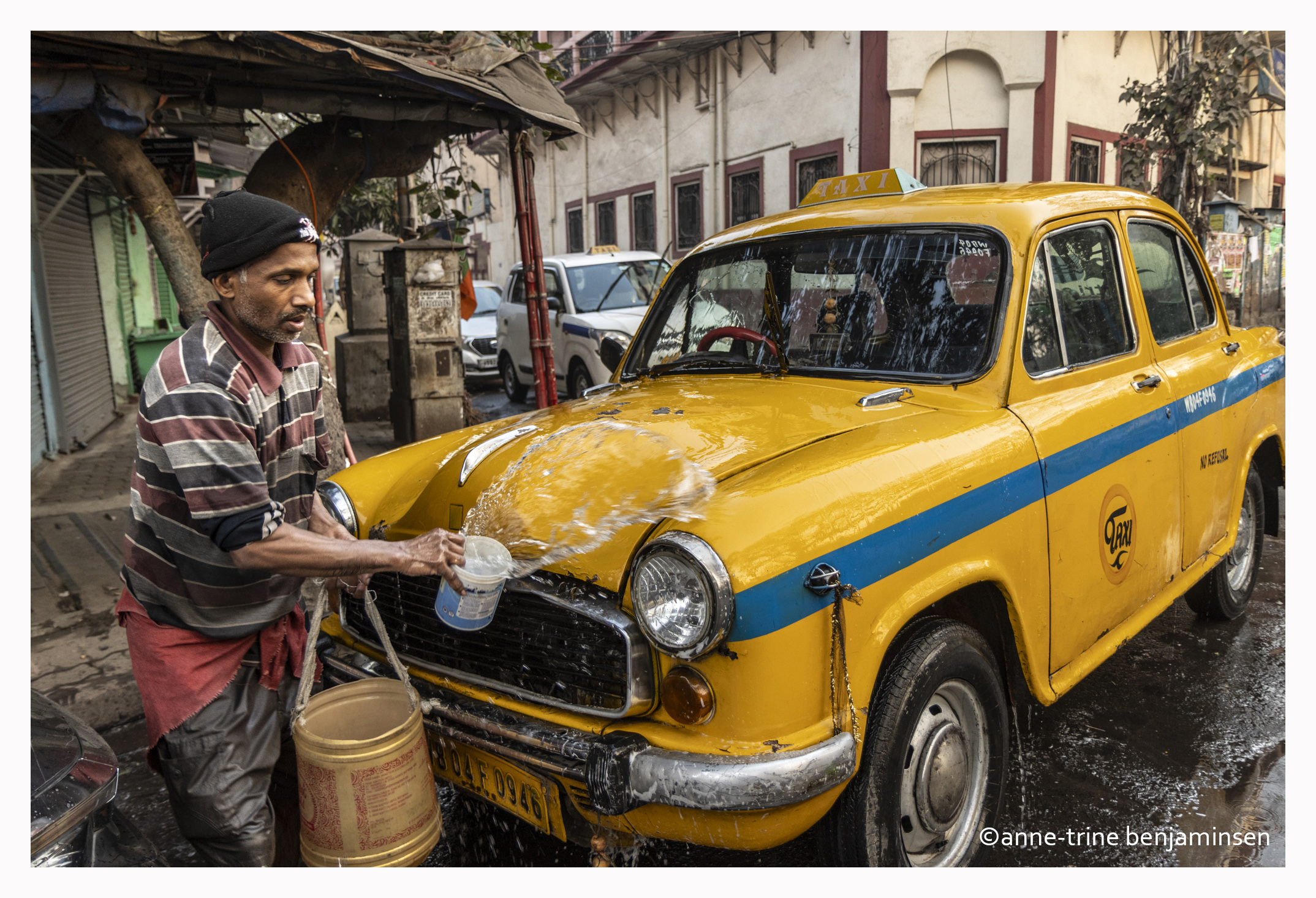
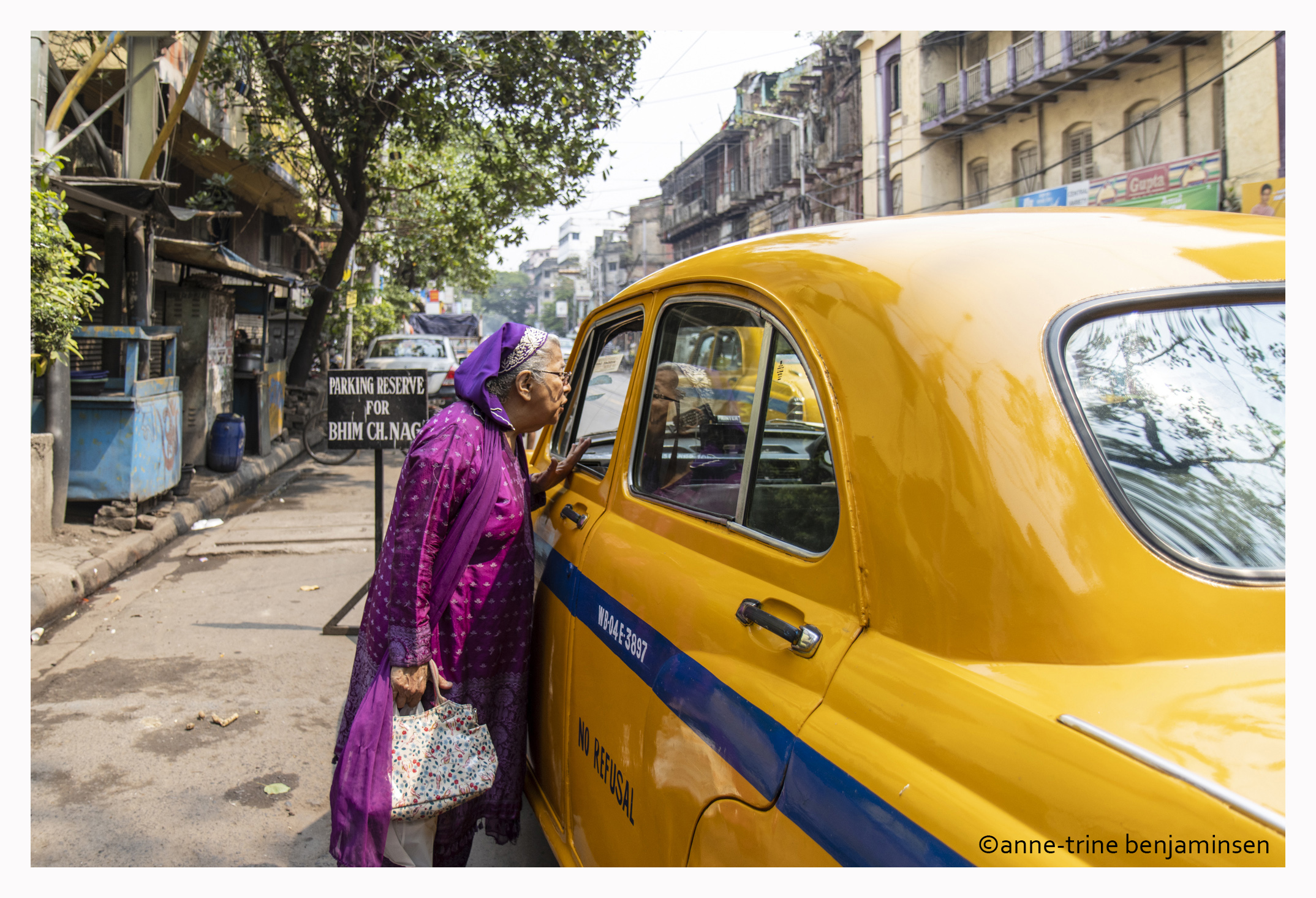
The rickshaw seems like an efficient solution, because the traffic is tough in Calcutta. The iconic yellow taxis very often refuse to take passengers, for reasons I cannot fathom (other than that they earn enough, or they think it too troublesome to go certain places at certain times of the day).

Beautifully hand-painted rickshaws at Park Circus, Calcutta.

I have never seen a single (white) tourist being transported by a hand pulled rickshaw, although it must certainly happen from time to time. I have debated with myself whether I should try it out, or not. After all, being a rickshaw wallah is a job like any other and should be respected. And the rickshaw wallahs are often immigrants, hailing from poor, neighbouring states like Bihar and Odisha. So why shouldn’t I support them, instead of the lazy taxi drivers? But somehow, I can’t see myself perching on the seat of a rickshaw, but it might just be a wonderful way to experience the streets of Calcutta.

Goods are also transported by the hand pulled rickshaws.
Children are taken to school.

Unfamiliar with Calcutta, one might easily condemn the hand pulled rickshaws. But once there, all the men plying the streets of Calcutta pulling rickshaws and carts, or running through the streets carrying enormous loads of goods on their heads, they all seem to belong, and I can’t imagine Calcutta without them. Whether it is right or wrong, it’s not for me to judge in this piece of writing.

Peace, on a busy Calcutta street …
A common sight on the streets of Calcutta.
 

A chance meeting in Calcutta March 10, 2020

Filed under: INDIA,Travels — benjamuna @ 7:51 am
Tags: , , ,

Whenever I get a new guide book, I look up the shopping section and search for book shops. As was also the case when I opened my new ’Made in Kolkata’ and found Earthcare Books. Located only a short walk off Park Street, the shop was an easy find on Middelton street. I walked into a courtyard and found the shop behind a cafe.

        Earthcare Books is small and just the kind of bookstore I love, it also has a section for gifts and cards. But what caught my attention was the black and white postcards and prints by Irish photographer Thomas Patrick Kiernan. The photographs were taken on the streets of Calcutta and in some other cities in India; the motifs well known, but captured beautifully.

        Having singled out a few books for a maybe-later-buy, and picked a few postcards, I asked the man behind the desk for the price of the prints. “10 000 rupees he said,” which struck me as steep and too much for an impulsive buy.

        I returned to the shop three days later. When I entered the courtyard, I noticed a man, obviously European, sitting outside the bookshop. We greeted briefly, and I entered the shop. I didn’t waste any time, I once more asked the same young man about the price (I could always have misheard him three days earlier), and he confirmed the 10 000 rupees. As my home-stay doubles as an art gallery, I had consulted my host and knew what I had to ask: Did the prints have an edition?
        “No, they don’t,” a voice behind me said. It was the man outside the shop, he must have overheard the conversation and instinctively I knew he was the photographer – which he confirmed. I immediately felt ashamed about complaining about the price, and he must have understood, because he said, «You have any right to question the price.»
        And then he went on to explain that if he numbered the prints, he would never be able to guarantee that no more prints would be made. So, better not. He invited me to sit down, and the conversation lasted for the next hour. He told me he was using old fashioned film and even in India it’s expensive to buy and develop.  The paper was of a very high quality and thus expensive. «On that, I don’t budge, but it makes the prints more expensive», he said.

        He offered me chai, and went out to fetch it. When the small clay cup was placed in front of me, I asked him about his camera. He picked up a small Olympus up from his bag, looking vintage – after all it’s not digital, and told me he’s always using a 50 mm fixed lens. I’m not surprised. There seems to be two kinds of photographers, especially those concerned with street photography: Those with a bag full of lenses, ready to cater for any situation. And those swearing to a fixed lens.

Kiernan claims it’s less than ten copies in circulation of this particular print, I got the last. “It might become valuable,”, he smiled.

I asked him to convince me to buy The Clock, the print I had singled out, but he wouldn’t. “I’m no business man, I don’t really care if I sell my work or not.” A remark he immediately seemed to regret; I don’t think it was his intention to degrade his potential buyer.

        He told me he couldn’t stay in Calcutta, or India for that matter, for more than a few months at a time, it was too much of … everything. He would go back to Ireland and do odd jobs, like gardening, but he had some money and could live a relatively comfortable life. An old Nokia phone by his side told me his needs weren’t too extravagant, and web pages and social media had absolutely no place in his life.

        “Street photography in Europe is boring,” he said. “I have tried, but it came to nothing.” And we agreed that India is quite the opposite, overflowing with all kind of craze. He picked up some of the postcards I had chosen, and added, “These photos from the 90’s can’t be reproduced today. Calcutta is changing, and so is India.”

        He told me how he worked, how he never planned or staged anything, and yet, his compositions are not always accidental, he showed me several of his photos with a ‘twin motif’ and only a gifted photographer would able to put his ideas into action like that. “I shan’t deny that I’m influenced by Henri Cartier-Bresson,” he said, and picked up some of the French photographer’s books to show me.

        Now, he is slightly adopting a new style, and opened a mock-up of his new book, his previous book sadly out of print a long time ago. And that convinced me; the last copy of The Clock – leaning on a shelf above the entrance door, had to be mine. I would have to let go of the frame though; it would never fit into my carry-on which was all the luggage I had.

I happily walked out with the small tube containing the print, crossed the street, hurried up Little Russel Street, crossed Ho Chi Minh Street and entered into the noisy Shakespeare Sarani. I knew the way by heart now and I’d probably visit again once back in Calcutta.