
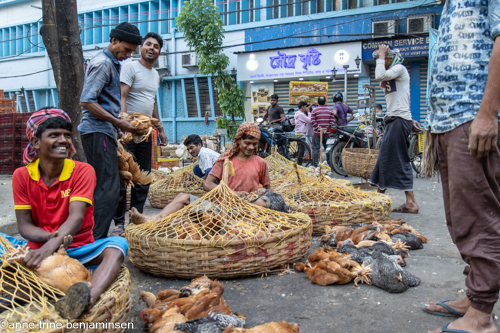
On my very first visit to Calcutta I found myself in a car driving through a street lined with cross-legged men in front of big, flat wicker baskets with chickens. I had no idea about the lay-out of Calcutta and I couldn’t ask the driver to stop, but I made a mental note of the sight and promised myself to come back. This spring, while planning a photo excursion in Calcutta, I tried to explain my to-be guide, Manjit, what I had seen. – Ha ha, he said, I know what you saw. I’ll take you there.
And he took me to Free School Street.
We set out in the early morning, 6 am to be precise. I had no idea that Free School Street was so close to my lodgings and made another mental note later that day: I could easily walk back another day and watch the whole ‘show’ again. In the wee hours the street was bustling with life, but not crowded. Come to think of it now, I didn’t see a single woman among men of all ages doing the same job: bundling up hens.

At first, I thought the chickens were dead, it wasn’t particularly lively in the wicker baskets. Some were covered by nets, but the chickens didn’t seem like they were about to fly the scene. The men didn’t mind my presence, maybe because of Manjit who constantly stroke up conversations with people who seemed to know his face. I knew I was observing daily life in Calcutta, this was not some kind of a zoo. If the men had found me and my camera intruding, it was their right.

I was appalled by the sight though, that was – I shan’t deny it – very pleasing to the camera lens, otherwise not. The men collected the chickens in pairs of twos and instead of placing them on the ground less than an arm length away they simply threw them on the ground. The chickens landed with a smack.
So that was their next station, now waiting to be picked up by buyers that either came by taxi or – for the most part – by bicycle or any other simple vehicle. Some bicycles became so loaded with chickens it was barely enough space for somebody to jump on.

The ride through the city would be the animals’ last journey, still very much alive (but not exactly kicking), hanging from their feet, watching the world upside down – if they ever noticed. They would reach their final destination, like a wholesale market or a shop, a restaurant or a hotel, as fresh as they could be.
I have seen enough in India to make me a vegetarian the minute I enter the country, sad to say. Not only as a matter of principle; the sight of Free School Street goes against anything I feel about animal welfare. But although many tourists eat well in India and tolerate the food without any problems, the hygiene is sometimes a far cry from homely hygiene measures and one should take precautions to stay away from the dreaded ‘Dehli belly’. Still, this is the way things work and this is how many people earn a living.
I spent at least a couple of hours taking in the atmosphere while walking slowly towards the end of the street. More and more bicycles entered the scene, deals were done, money exchanged – and the men pedalled away with their load.
I noticed a man hanging his clothes to dry on a clothesline on the blue wall behind him. Wearing a checked, blue lungi he seemed to have dressed for the occasion; the matching colours acted like a magnet to my camera. His wicker baskets were empty, instead his chickens lay in two heaps on the pavement. They didn’t stir, but kept their heads high. As if keeping their dignity alive to the bitter end.


It was a few days later that I discovered how close Free School Street was to my lodgings in Auckland Square. After a visit to the New Market (where the destiny of some of the hens was relieved to me in a spectacle of feathers and blood) I had been told to walk Free School Street all the way up to Park Street and I would then find myself more or less ‘at home’. At noon, the street looked nothing like the 6 o’clock sights when I had to kneel to get the best shots. Normality prevailed, people were walking on the pavements instead of smacking hens towards the asphalt. I could never have told that it was the same street.
END
PHOTOGRAPHY TIPS: I spent eight hours in the company of calcuttaphototours






 Benjamuna's Blog